

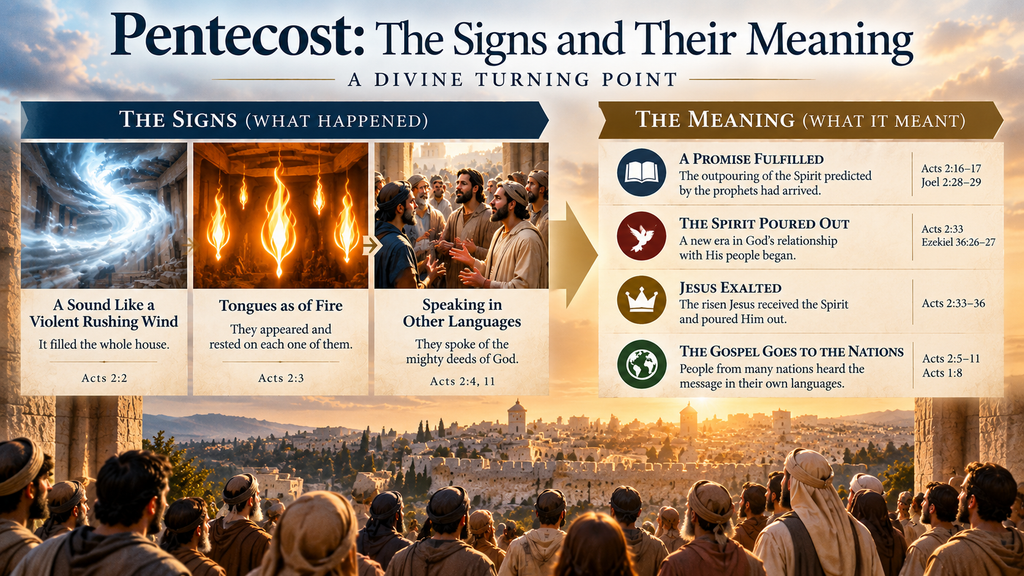
Few events in the New Testament are as dramatic as the Day of Pentecost. There was a sound like a violent rushing wind. Something resembling tongues of fire appeared. The followers of Jesus began speaking in languages they had never learned. A crowd gathered, thousands heard the gospel, and about three thousand people responded to Peter’s message.
Because the miraculous signs are so striking, it is easy to focus almost entirely on them. But Pentecost was about much more than wind, fire, and speaking in tongues. It marked the fulfillment of promises God had been making for centuries. It demonstrated that the risen Jesus had been exalted to the right hand of God. It empowered the apostles to begin their worldwide mission, and it announced that the promised age of the Holy Spirit had arrived.
To understand Pentecost, we need to look not only at what happened, but at what Peter said those events meant.
Why Were They Waiting in Jerusalem?
After His resurrection, Jesus appeared to His disciples over a period of forty days. Before returning to the Father, He gave them an unusual instruction. Although they had been commissioned to carry His message to the world, they were not supposed to begin immediately.
They were told to wait.
“He commanded them not to leave Jerusalem, but to wait for what the Father had promised, ‘Which,’ He said, ‘you heard of from Me; for John baptized with water, but you will be baptized with the Holy Spirit not many days from now.’” (Acts 1:4 – 5)
Jesus had already given them their mission. They were to make disciples of all nations. But before beginning that mission, they needed what God had promised.
Jesus explained:
“But you will receive power when the Holy Spirit has come upon you; and you shall be My witnesses both in Jerusalem, and in all Judea and Samaria, and even to the remotest part of the earth.” (Acts 1:8)
The coming of the Holy Spirit and the mission of the apostles were therefore directly connected. The Spirit would empower them to become witnesses of the risen Christ, beginning in Jerusalem and eventually carrying the gospel throughout the world.
The Day of Pentecost Arrived
Pentecost was already an important Jewish feast long before the events recorded in Acts 2. It occurred fifty days after Passover and was associated with the Feast of Weeks. Jews from many different regions traveled to Jerusalem for the celebration.
That helps explain why the timing was so significant. Jerusalem was filled with Jewish worshipers and converts from many different parts of the world. Acts mentions people from Parthia, Media, Mesopotamia, Cappadocia, Egypt, Rome, Arabia, and numerous other regions.
Into that setting came the event Jesus had promised:
“When the day of Pentecost had come, they were all together in one place. And suddenly there came from heaven a noise like a violent rushing wind, and it filled the whole house where they were sitting.” (Acts 2:1 – 2)
Something extraordinary was happening, and Luke, the author of Acts, is careful about the language he uses. He does not say there was literally a violent wind. He says there was a sound from heaven like a violent rushing wind.
Then came another visible sign.
What Were the Tongues of Fire?
Acts continues:
“And there appeared to them tongues as of fire distributing themselves, and they rested on each one of them.” (Acts 2:3)
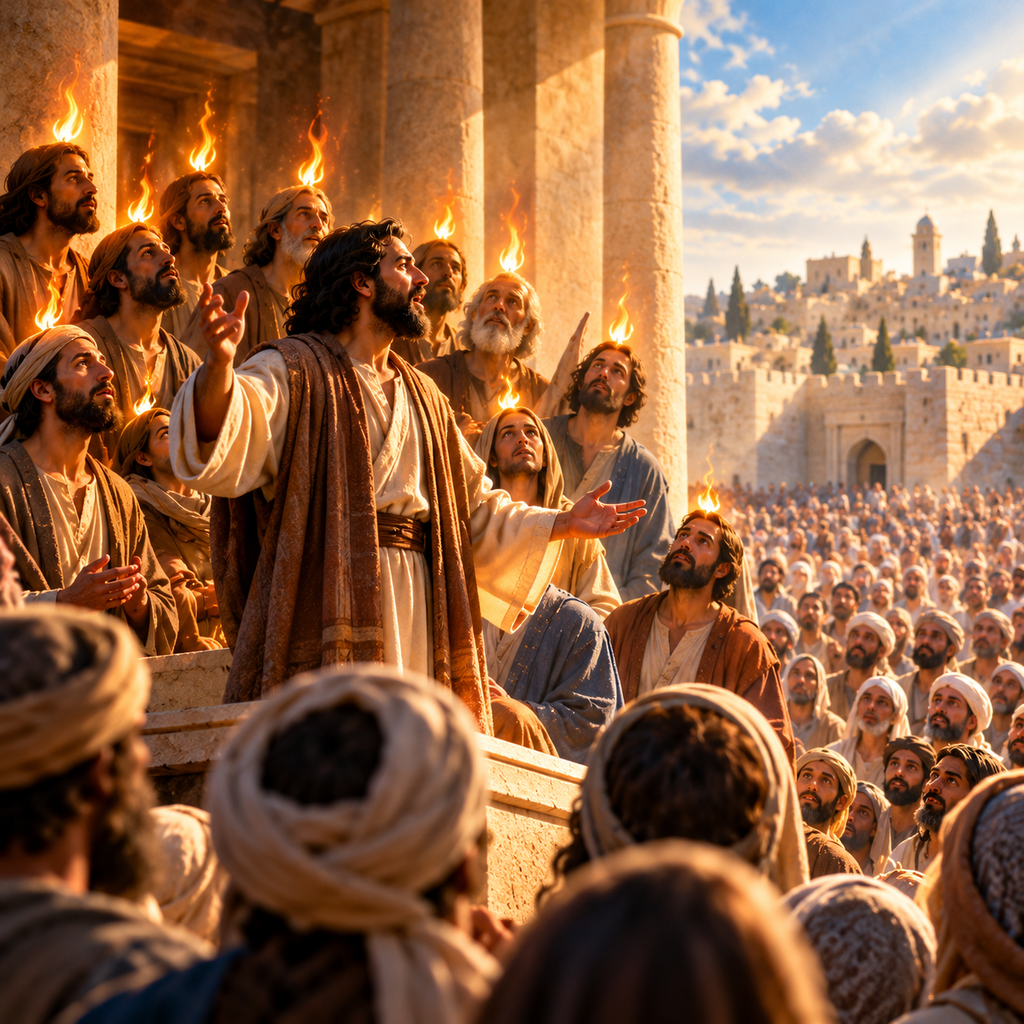
Again, notice Luke’s wording. He says they appeared as tongues of fire. The text describes a visible manifestation that resembled fire rather than simply saying that the disciples were physically burning.
Fire has powerful associations throughout Scripture. God appeared to Moses in the burning bush. Fire accompanied God’s presence at Mount Sinai. A pillar of fire led Israel through the wilderness. Fire could symbolize God’s presence, holiness, judgment, and power.
Acts does not explicitly tell us everything the appearance of fire symbolized, so we should be cautious about going beyond what Scripture says. What is clear is that this was a visible supernatural sign accompanying the arrival of the promised Spirit.
The sound drew attention. The visible signs demonstrated that something extraordinary was occurring. But then came the sign that the crowd itself could directly experience.
They Began Speaking in Other Languages
Luke tells us:
“And they were all filled with the Holy Spirit and began to speak with other tongues, as the Spirit was giving them utterance.” (Acts 2:4)
The word tongues can sound mysterious to modern readers, but the rest of the passage helps us understand what was happening. The people gathered in Jerusalem heard the disciples speaking in their own native languages.
“And how is it that we each hear them in our own language to which we were born?” (Acts 2:8)
Acts then lists the many regions represented in the crowd. These were recognizable human languages. The miracle was not that the listeners somehow interpreted meaningless sounds. The speakers were miraculously enabled by the Spirit to speak languages they had not learned, and people from different nations understood them.
What were they saying?
“We hear them in our own tongues speaking of the mighty deeds of God.” (Acts 2:11)
The miraculous languages had a purpose. They drew attention to God’s work and provided a sign that something extraordinary was taking place.
Why These Particular Languages?
The setting makes the miracle especially meaningful. God had chosen Jerusalem as the starting point for the worldwide mission Jesus had given His apostles. Yet gathered in Jerusalem that day were people from nations scattered across the known world.
They suddenly heard the mighty works of God proclaimed in their own languages.
There is a striking contrast with the story of Babel in Genesis 11. At Babel, languages contributed to the scattering of humanity. At Pentecost, different languages became a means through which people from many nations heard the same message about God.
We should be careful not to force that comparison beyond what Scripture explicitly says, but the larger biblical movement is difficult to miss. The gospel of Jesus was not going to remain confined to one language, one nation, or one ethnic group.
The mission Jesus described in Acts 1:8 had begun.
What Did the Crowd Think?
The reaction was mixed. Many people were amazed and perplexed:
“And they all continued in amazement and great perplexity, saying to one another, ‘What does this mean?’” (Acts 2:12)
Others were less impressed:
“But others were mocking and saying, ‘They are full of sweet wine.’” (Acts 2:13)
Peter stood up to explain what was actually happening. His explanation is critical because it prevents us from having to guess about the meaning of Pentecost. Peter did not say, “This is primarily about speaking in tongues.” He pointed instead to the promises of God.
Peter Said This Was the Fulfillment of Joel
Peter began by rejecting the accusation that the disciples were drunk. It was only about nine o’clock in the morning. He then explained:
“But this is what was spoken of through the prophet Joel.” (Acts 2:16)
Peter quoted the prophecy we examined in the previous article:
“And it shall be in the last days,” God says, “That I will pour forth of My Spirit on all mankind…” (Acts 2:17)
This tells us what Pentecost fundamentally represented. God was fulfilling His promise to pour out His Spirit. The Spirit had been active throughout the Old Testament. But Joel had looked forward to a broader outpouring that would cross boundaries of age, sex, and social position. Peter announced that the fulfillment of that promise had begun.
Peter’s Sermon Was About Jesus
This is one of the most important details in Acts 2. After explaining the outpouring of the Spirit, Peter immediately began preaching about Jesus. He reminded the crowd of Jesus’ miracles. He spoke about His crucifixion. He argued from the Psalms that the Messiah would rise from the dead. Then Peter declared:
“This Jesus God raised up again, to which we are all witnesses.” (Acts 2:32)
The central message of Pentecost was not the Holy Spirit separated from Jesus. The coming of the Spirit confirmed the identity and victory of Christ.
Peter continued:
“Therefore having been exalted to the right hand of God, and having received from the Father the promise of the Holy Spirit, He has poured forth this which you both see and hear.” (Acts 2:33)
This verse connects everything together. Jesus had been raised from the dead. He had been exalted to the right hand of God. He had received the promised Spirit from the Father, and He had now poured out the Spirit.
What the crowd could see and hear was evidence that Jesus was alive, exalted, and reigning.
“God Has Made Him Both Lord and Christ”
Peter brought his sermon to its climax with a direct declaration:
“Therefore let all the house of Israel know for certain that God has made Him both Lord and Christ – this Jesus whom you crucified.” (Acts 2:36)
The crowd had witnessed the miraculous signs of Pentecost, but Peter’s goal was not simply to leave them amazed. He wanted them to understand what those signs demonstrated about Jesus.
This is a perfect example of the principle we discussed in Article 5: the Holy Spirit glorifies Christ.
The Spirit arrived with extraordinary signs, but those signs pointed beyond themselves. Peter used the event to proclaim the death, resurrection, exaltation, and lordship of Jesus.
The Crowd Asked, “What Shall We Do?”
Peter’s message produced a powerful response:
“Now when they heard this, they were pierced to the heart, and said to Peter and the rest of the apostles, ‘Brethren, what shall we do?’” (Acts 2:37)
Peter answered:
“Repent, and each of you be baptized in the name of Jesus Christ for the forgiveness of your sins; and you will receive the gift of the Holy Spirit.” (Acts 2:38)
Then he added:
“For the promise is for you and your children and for all who are far off, as many as the Lord our God will call to Himself.” (Acts 2:39)
About three thousand people responded that day and were baptized.
The significance is difficult to overstate. Pentecost did not end with the apostles receiving the Spirit. Peter announced that the promise extended to others. What had begun with a relatively small group of disciples was becoming the life of a rapidly growing community of believers.
Pentecost Was the Beginning, Not the End
Sometimes Pentecost is treated as though Acts 2 were the entire story of the Holy Spirit. But Acts 2 is really the beginning of a much larger story.
Jesus had told His apostles that they would be His witnesses in Jerusalem, Judea, Samaria, and to the remotest part of the earth. The book of Acts follows that progression. The gospel begins in Jerusalem and then moves outward. Samaritans receive the message. An Ethiopian official believes. Saul, one of the church’s fiercest persecutors, becomes an apostle. Then something happens that many Jewish Christians had not expected: Gentiles begin receiving the Holy Spirit too.
Pentecost opened the door to the worldwide mission of the church.
What Pentecost Really Means
When we put the pieces together, Pentecost becomes much larger than a discussion about tongues. The miraculous languages were real and important, but they were part of a much greater event.
Pentecost fulfilled the promise of the prophets. It fulfilled Jesus’ promise to send the Helper. It empowered the apostles to become witnesses. It publicly demonstrated the exaltation of Jesus. It announced the beginning of the promised outpouring of the Spirit. It launched the worldwide proclamation of the gospel. And it opened a new chapter in God’s relationship with His people.
The sound like rushing wind was dramatic. The appearance of fire was dramatic. Speaking in previously unknown languages was dramatic. But Peter directed the crowd beyond the signs to their meaning.
Jesus had risen. Jesus had been exalted. Jesus was Lord. And He had poured out the promised Holy Spirit.
That is the heart of Pentecost.
But the story soon took an unexpected turn. The Jewish believers had received the Spirit in Jerusalem. What would happen when the gospel reached people who were not Jewish at all? Would Gentiles have to become Jews before they could fully belong to God’s people?
God answered that question in dramatic fashion in the home of a Roman centurion named Cornelius. That is where we turn next: Why Did the Holy Spirit Come Upon Cornelius?
Want to Go Deeper?
This article is adapted from my book, Understanding the Holy Spirit: A Scriptural Study Guide. If you’d like to explore the Holy Spirit in greater depth, including His indwelling presence, His work in our lives, the fruit of the Spirit, being filled with the Spirit, spiritual gifts, and much more, the complete study is available on Amazon.