

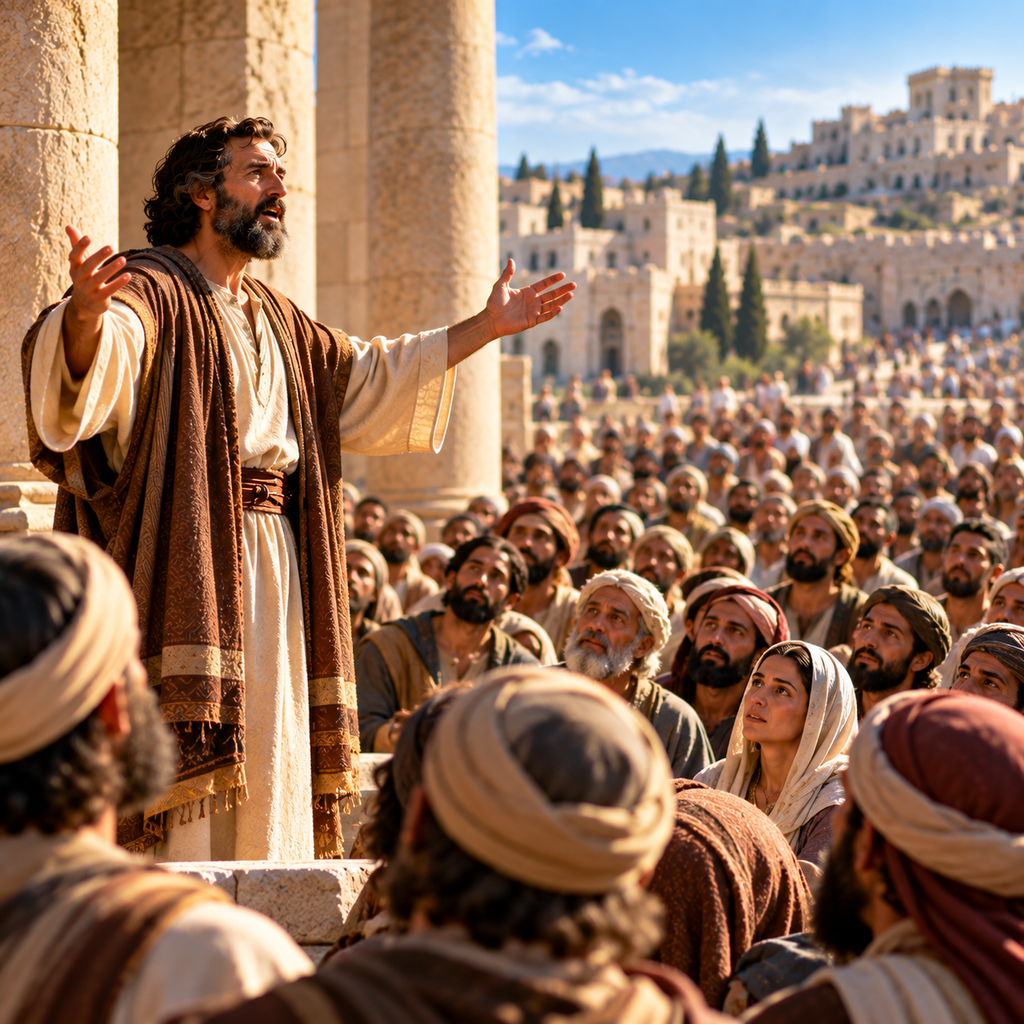
On the Day of Pentecost, Peter preached one of the most important sermons in the New Testament. He proclaimed that Jesus had been crucified, raised from the dead, exalted to the right hand of God, and declared both Lord and Christ. The people listening were deeply convicted.
They asked Peter and the other apostles a simple question:
“Brethren, what shall we do?” (Acts 2:37)
Peter answered:
“Repent, and each of you be baptized in the name of Jesus Christ for the forgiveness of your sins; and you will receive the gift of the Holy Spirit.” (Acts 2:38)
That last phrase has generated an enormous amount of discussion: “the gift of the Holy Spirit.” What exactly did Peter promise?
Was he saying that everyone who responded would receive a miraculous spiritual gift like speaking in tongues? Was “the gift” some particular ability given by the Spirit? Or was Peter promising something even more fundamental – the Holy Spirit Himself?
The distinction matters because the New Testament speaks both about the Holy Spirit as God’s gift to believers and about gifts that the Holy Spirit gives. Those are related ideas, but they are not the same thing.
Start With Peter’s Actual Words
It is helpful to begin without importing later questions into the passage. Peter does not tell the crowd, “You will receive a spiritual gift.” He says they will receive “the gift of the Holy Spirit.”
The most natural way to understand that statement is that the Holy Spirit Himself is the gift. God is promising His Spirit to those who respond to the gospel.
Peter’s next statement strengthens that conclusion:
“For the promise is for you and your children and for all who are far off, as many as the Lord our God will call to Himself.” (Acts 2:39)
Peter describes what he has just announced as “the promise.” That should immediately remind us of what Jesus had said shortly before Pentecost.
Jesus Called the Holy Spirit the Father’s Promise
Before His ascension, Jesus told His apostles:
“And behold, I am sending forth the promise of My Father upon you…” (Luke 24:49)
Luke explains the same promise at the beginning of Acts:
“He commanded them not to leave Jerusalem, but to wait for what the Father had promised…” (Acts 1:4)
Jesus then identified that promise with the coming of the Holy Spirit:
“For John baptized with water, but you will be baptized with the Holy Spirit not many days from now.” (Acts 1:5)
So when Peter says at Pentecost, “the promise is for you,” his language fits the larger story perfectly. God had promised the coming of His Spirit. That promise was now being extended beyond the apostles to others who responded to Christ.
The Holy Spirit Is Described as a Gift Elsewhere in Acts
Acts itself gives us additional evidence. In the previous article, we looked at Cornelius and his household. While Peter was preaching to them, the Holy Spirit came upon the Gentile listeners.
Luke describes the reaction of the Jewish believers who accompanied Peter:
“All the circumcised believers who came with Peter were amazed, because the gift of the Holy Spirit had been poured out on the Gentiles also.” (Acts 10:45)
Notice the wording. The “gift of the Holy Spirit” was poured out upon the Gentiles.
When Peter later explained what had happened, he said:
“Therefore if God gave to them the same gift as He gave to us also after believing in the Lord Jesus Christ, who was I that I could stand in God’s way?” (Acts 11:17)
The gift was God’s Spirit. The miraculous manifestation accompanying the event demonstrated that the gift had been received, but the Spirit Himself was the gift God had given.
The Gift Is Not the Same as the Gifts
This distinction becomes especially important because the New Testament also talks about gifts of the Spirit. Paul discusses these extensively in 1 Corinthians 12.
He writes:
“Now there are varieties of gifts, but the same Spirit.” (1 Corinthians 12:4)
Paul then lists different manifestations of the Spirit, including wisdom, knowledge, faith, healing, miracles, prophecy, distinguishing of spirits, tongues, and interpretation of tongues.
But notice what Paul says about their distribution:
“But one and the same Spirit works all these things, distributing to each one individually just as He wills.” (1 Corinthians 12:11)
Not everyone receives the same spiritual gift. In fact, Paul later asks a series of rhetorical questions:
“All are not apostles, are they? All are not prophets, are they? … All do not speak with tongues, do they?” (1 Corinthians 12:29 – 30)
The expected answer is no.
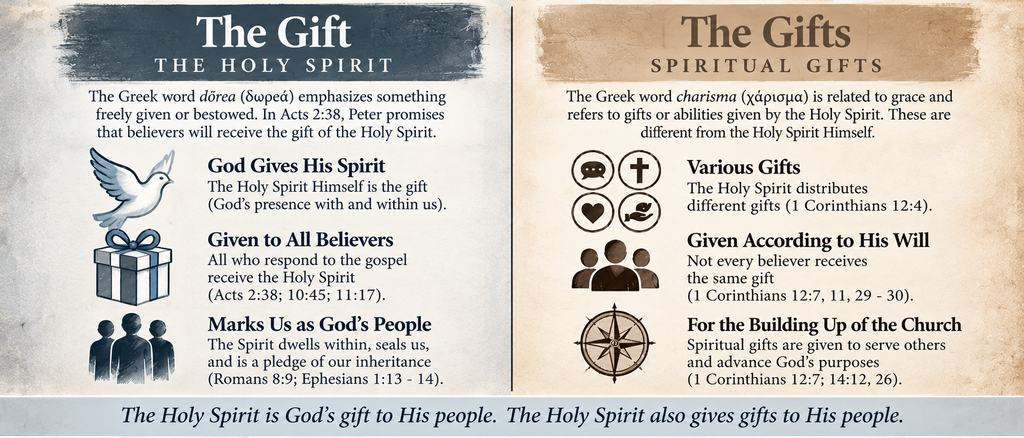
That gives us an important distinction. The Holy Spirit is God’s gift to His people, while the Spirit distributes different gifts according to His will. Receiving the Spirit does not mean that every Christian must receive the same spiritual ability.
The Greek Words Help Us See the Difference
There is an interesting distinction in the Greek vocabulary that supports what we have seen. When Peter promises “the gift of the Holy Spirit” in Acts 2:38, the word translated gift is dōrea. It refers to something freely given or bestowed.
Significantly, Luke uses the same word when describing what happened in the household of Cornelius:
“All the circumcised believers who came with Peter were amazed, because the gift of the Holy Spirit had been poured out on the Gentiles also.” (Acts 10:45)
When Peter later explains the event in Jerusalem, he again describes the Holy Spirit as God’s gift:
“Therefore if God gave to them the same gift as He gave to us also after believing in the Lord Jesus Christ, who was I that I could stand in God’s way?” (Acts 11:17)
When Paul discusses the different spiritual gifts distributed among Christians, however, he commonly uses another word, charisma, which is related to the Greek word for grace, charis:
“Now there are varieties of gifts, but the same Spirit.” (1 Corinthians 12:4)
We should not make more of the vocabulary than the text allows. Greek words can have overlapping meanings, and context must determine how they are being used. Still, the wording fits an important distinction found throughout these passages: the Holy Spirit is God’s gift to His people, while the Holy Spirit distributes gifts to God’s people.
But Didn’t Everyone Speak in Tongues at Pentecost?
This is where some confusion arises. Acts 2 begins with a group of Jesus’ followers being filled with the Holy Spirit and speaking in other languages. Later in the chapter, Peter tells thousands of listeners that they too can receive the gift of the Holy Spirit.
It can therefore be tempting to assume that Peter was promising all of them the exact same miraculous experience.
But the text never says that the approximately three thousand people baptized that day began speaking in tongues. Luke certainly knew how to report such an event. He had just described the miraculous languages earlier in the chapter. Yet when he describes the three thousand responding to Peter’s message, he says:
“So then, those who had received his word were baptized; and that day there were added about three thousand souls.” (Acts 2:41)
There is no mention of tongues, fire, rushing wind, or any other miraculous manifestation among the three thousand.
That does not prove that no miraculous gifts were present among any of them. But it does mean we should not add something to the text that Luke does not tell us happened.
Not Every Reception of the Spirit Looks the Same in Acts
The book of Acts records several occasions when people receive the Holy Spirit, and the circumstances are not identical in every case.
At Pentecost, miraculous languages accompany the coming of the Spirit. In Samaria, believers receive the Holy Spirit through the laying on of the apostles’ hands (Acts 8:14 – 17). At Cornelius’s house, the Spirit comes upon the Gentiles while Peter is still preaching, and they speak in tongues (Acts 10:44 – 46). In Ephesus, Paul lays his hands on a group of disciples, and they speak in tongues and prophesy (Acts 19:6).
These passages deserve careful study, and we will return to several of them later. But we should notice something immediately: Acts does not present one mechanical sequence that looks exactly the same in every situation.
Acts records a unique period in salvation history when the gospel was moving outward from its Jewish beginning into Samaria and then into the Gentile world. Some of the extraordinary manifestations of the Spirit served as visible confirmation that God was crossing boundaries and accepting people whom the earliest Jewish believers might not have expected Him to accept.
The Spirit Dwells Within God’s People
When we move beyond Acts and examine the letters written to established churches, the picture becomes even clearer. The Holy Spirit is not presented as belonging only to Christians who possess miraculous gifts. His presence is fundamental to belonging to Christ.
Paul writes:
“However, you are not in the flesh but in the Spirit, if indeed the Spirit of God dwells in you. But if anyone does not have the Spirit of Christ, he does not belong to Him.” (Romans 8:9)
That is a remarkably strong statement. Paul does not divide Christians into those who have the Spirit and those who do not. The presence of the Spirit is part of what identifies someone as belonging to Christ.
He makes a similar point to the Corinthians:
“Do you not know that you are a temple of God and that the Spirit of God dwells in you?” (1 Corinthians 3:16)
The Holy Spirit is not merely an external source of occasional supernatural power. He dwells within God’s people.
The Spirit Is God’s Pledge of What Is Coming
Paul also describes the Holy Spirit as God’s seal and pledge given to believers:
“In Him, you also, after listening to the message of truth, the gospel of your salvation – having also believed, you were sealed in Him with the Holy Spirit of promise.” (Ephesians 1:13)
Notice Paul’s phrase: “the Holy Spirit of promise.” Once again, the language echoes the promise we have been tracing from the prophets through Jesus and into Acts.
Paul continues:
“Who is given as a pledge of our inheritance…” (Ephesians 1:14)
The Spirit’s presence is God’s assurance that believers belong to Him and that He will complete what He has promised.
Paul uses similar language elsewhere:
“Now He who prepared us for this very purpose is God, who gave to us the Spirit as a pledge.” (2 Corinthians 5:5)
Again, the Spirit Himself is something God gives.
God Gives the Holy Spirit to His People
This language is not limited to Paul. Peter himself later says:
“And we are witnesses of these things; and so is the Holy Spirit, whom God has given to those who obey Him.” (Acts 5:32)
The language is straightforward. God gives the Holy Spirit.
That fits naturally with Peter’s promise in Acts 2:38. Those who responded to Christ would receive forgiveness and God’s promised Spirit. The gift was not merely a supernatural ability that some Christians might possess. It was the presence of God Himself among and within His people.
Something Greater Than a Miraculous Ability
Miraculous spiritual gifts naturally attract our attention. Speaking a language one has never learned, healing the sick, or delivering a prophetic message is dramatic. But if we focus entirely on those manifestations, we can miss something even more extraordinary.
God gives His Spirit to His people.
The prophets had looked forward to this. Ezekiel recorded God’s promise:
“I will put My Spirit within you and cause you to walk in My statutes…” (Ezekiel 36:27)
Jesus promised that the Helper would not merely be with His followers:
“You know Him because He abides with you and will be in you.” (John 14:17)
This is the greater reality toward which the biblical story had been moving. God would dwell within His people through His Spirit.
The Gift Is the Giver
When Peter promised “the gift of the Holy Spirit,” he was announcing something far greater than the promise of a particular supernatural ability. God was giving His people the Holy Spirit Himself.
The Spirit may give gifts, and Scripture describes a variety of them. But the gifts should never overshadow the Giver.
The Holy Spirit’s presence means that Christians belong to God. He dwells within them. He marks them as God’s people. He is God’s pledge of their inheritance. He helps them in their weakness. He transforms them. He produces His fruit within them. And He increasingly shapes them into the likeness of Christ.
That brings us to an even more personal question. If the Holy Spirit is God’s gift to His people and actually dwells within believers, what does that mean for everyday Christian life?
That is where we turn next: What Does It Mean to Have the Holy Spirit Living in You?
Want to Go Deeper?
This article is adapted from my book, Understanding the Holy Spirit: A Scriptural Study Guide. If you’d like to explore the Holy Spirit in greater depth, including His indwelling presence, His work in our lives, the fruit of the Spirit, being filled with the Spirit, spiritual gifts, and much more, the complete study is available on Amazon.