

One of the most remarkable promises in the New Testament is that God gives His Holy Spirit to dwell within His people. Think about that for a moment. The same Spirit who was present at creation, who inspired the prophets, who empowered the apostles, and who raised Jesus from the dead is described as living within Christians.
That is an extraordinary statement. But what does it actually mean? Does the Holy Spirit literally live inside our bodies? Should we be able to feel His presence? Does He speak to us directly? How does His indwelling change the way we live?
These are important questions because the Holy Spirit’s presence is not presented in Scripture as an optional spiritual experience reserved for a select group of unusually devoted Christians. It is part of what it means to belong to Jesus Christ.
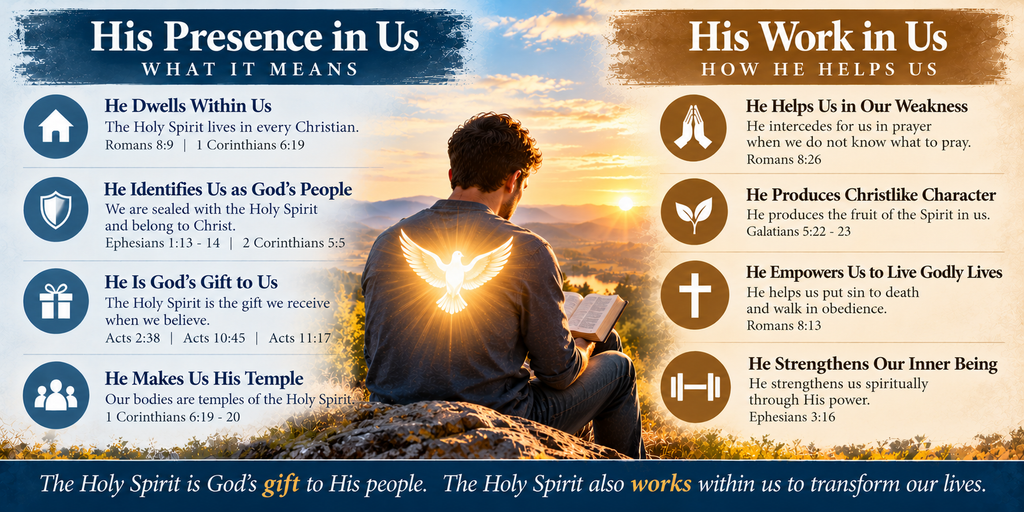
Jesus Promised That the Spirit Would Be in Us
During His final evening with the apostles, Jesus promised that the Father would send another Helper. He identified this Helper as the Holy Spirit and made a remarkable distinction:
“You know Him because He abides with you and will be in you.” (John 14:17)
To be clear, Jesus was talking specifically to the apostles. I don’t want to imply that everything said in this context applies to all Christians, but there are some things to learn here. Notice the difference between with you and in you. The Holy Spirit had already been active in the world and in the lives of God’s people. But Jesus was pointing toward something new in the relationship between the Spirit and His followers.
This was not an unexpected development. Centuries earlier, God had promised through Ezekiel:
“Moreover, I will give you a new heart and put a new spirit within you… I will put My Spirit within you and cause you to walk in My statutes.” (Ezekiel 36:26 – 27)
The promise was about more than external guidance or temporary empowerment. God intended to work within His people, transforming their hearts and helping them live according to His will.
The New Testament presents the indwelling Holy Spirit as a central feature of that new covenant relationship.
The Holy Spirit Dwells Within Every Christian
Paul makes one of the clearest statements about the indwelling Spirit in his letter to the Romans:
“However, you are not in the flesh but in the Spirit, if indeed the Spirit of God dwells in you. But if anyone does not have the Spirit of Christ, he does not belong to Him.” (Romans 8:9)
Paul does not describe two classes of Christians, one group that possesses the Holy Spirit and another that does not. Instead, he connects having the Spirit with belonging to Christ.
This is an important distinction because Christians sometimes associate the presence of the Holy Spirit primarily with dramatic spiritual experiences. They may assume that someone who speaks in tongues, receives a miraculous gift, or experiences an overwhelming emotional encounter has the Spirit in a way that ordinary Christians do not.
But Paul does not establish miraculous experiences as the defining evidence of belonging to Christ. He identifies the Spirit’s presence as fundamental to Christian identity.
The Holy Spirit is not a special reward reserved for a spiritual elite. He is God’s gift to His people.
Our Bodies Are Temples of the Holy Spirit
Paul uses an extraordinary illustration to describe the significance of the Spirit’s presence. Writing to Christians in Corinth, he asks:
“Or do you not know that your body is a temple of the Holy Spirit who is in you, whom you have from God, and that you are not your own?” (1 Corinthians 6:19)
To appreciate the force of Paul’s words, we need to understand the importance of the temple in the Old Testament. The tabernacle and later the temple represented God’s dwelling place among His people. They were sacred places associated with His presence and holiness.
Now Paul tells Christians that their own bodies are temples of the Holy Spirit.
This does not mean that God has become confined within our physical bodies. God is not limited by space, and His Spirit is not a physical substance occupying some particular location inside us. Rather, Paul is describing an extraordinary spiritual relationship in which God is genuinely present with His people.
And Paul immediately draws a practical conclusion:
“For you have been bought with a price: therefore glorify God in your body.” (1 Corinthians 6:20)
The indwelling Spirit is not simply something to admire or debate. His presence changes how we should think about our bodies, our conduct, and our relationship with God. We belong to Him.
Does the Holy Spirit’s Presence Have to Be Felt?
This is one of the most common questions Christians ask. If the Holy Spirit lives within me, shouldn’t I feel something?
Some Christians describe powerful emotional experiences associated with prayer, worship, repentance, or spiritual renewal. Such experiences can be meaningful, but Scripture does not teach that a particular physical sensation or emotional response is necessary to prove that the Holy Spirit dwells within someone.
Consider the Christians Paul addressed in Rome, Corinth, and Ephesus. He spoke of the Spirit dwelling within them, sealing them, and identifying them as God’s people. Yet he did not instruct them to verify the Spirit’s presence by looking for a particular sensation.
Instead, he pointed them toward their relationship with Christ and the transforming work of the Spirit.
This distinction matters because feelings can change dramatically. A Christian may experience great joy one day and discouragement the next. Some believers are naturally more emotional than others. If we make the Spirit’s presence dependent upon how strongly we feel something, we can create unnecessary uncertainty.
The Holy Spirit’s indwelling is a promise grounded in God’s Word, not a conclusion we must draw from our emotions.
The Spirit Is God’s Seal and Guarantee
Paul describes another important aspect of the indwelling Spirit in Ephesians:
“In Him, you also, after listening to the message of truth, the gospel of your salvation – having also believed, you were sealed in Him with the Holy Spirit of promise.” (Ephesians 1:13)
Paul continues by describing the Spirit as a pledge of our inheritance (Ephesians 1:14).
In the ancient world, a seal could indicate ownership, authenticity, or authority. Paul uses that imagery to communicate that the Holy Spirit identifies believers as belonging to God.
The word translated pledge carries the idea of a guarantee or down payment. God’s gift of the Spirit is an assurance that He intends to complete what He has promised.
Paul makes a similar statement elsewhere:
“Now He who prepared us for this very purpose is God, who gave to us the Spirit as a pledge.” (2 Corinthians 5:5)
The indwelling Spirit therefore points both backward and forward. His presence identifies us as people who belong to Christ, and it assures us of the inheritance God has promised.
This does not mean Christians can live however they please without regard for faithfulness. Scripture repeatedly warns believers against turning away from God. But it does mean that God’s gift of the Spirit is intended to provide confidence in His faithfulness rather than uncertainty about whether He is present.
The Holy Spirit Helps Us in Our Weakness
The Spirit’s indwelling is not merely a statement about our spiritual identity. Scripture also describes His active involvement in our lives.
Paul writes:
“In the same way the Spirit also helps our weakness; for we do not know how to pray as we should, but the Spirit Himself intercedes for us with groanings too deep for words.” (Romans 8:26)
There are times when Christians struggle to find the right words in prayer. We may not know what to ask for, how to express our concerns, or even what outcome would be best.
Paul reminds us that we are not alone in our weakness. The Spirit helps us and intercedes according to God’s will.
This is a deeply comforting truth. The Christian life is not simply a matter of trying harder, becoming more disciplined, or relying entirely upon our own strength. God has given His Spirit to help His people.
The precise manner in which the Spirit intercedes may remain mysterious, but the promise itself is clear. God knows our weakness, and His Spirit is involved in helping us.
The Spirit Helps Us Put Sin to Death
Another important work of the indwelling Spirit is helping Christians resist sin and grow in holiness.
Paul writes:
“For if you are living according to the flesh, you must die; but if by the Spirit you are putting to death the deeds of the body, you will live.” (Romans 8:13)
Notice the cooperation implied in this statement. Christians are responsible for putting sinful behavior to death, but they do so by the Spirit.
The Holy Spirit does not eliminate our responsibility to make decisions, resist temptation, or pursue righteousness. Nor does His presence mean that Christians will never struggle with sin.
Instead, the Spirit is actively involved in the process of spiritual transformation.
This helps us understand why the indwelling Spirit is so much more significant than a temporary emotional experience. His work is directed toward changing the way we live.
The Spirit Produces Christlike Character
Perhaps the most recognizable description of the Spirit’s transforming work appears in Galatians:
“But the fruit of the Spirit is love, joy, peace, patience, kindness, goodness, faithfulness, gentleness, self-control…” (Galatians 5:22 – 23)
These qualities are not presented as extraordinary abilities reserved for a few Christians. They describe the kind of character the Holy Spirit produces as believers walk according to His leading.
This is especially important when considering how we recognize the Spirit’s work in someone’s life.
A person may claim remarkable spiritual experiences or abilities, but Scripture places enormous emphasis on character. Is the person growing in love? Are patience and kindness becoming more evident? Is there greater self-control? Is the person’s life increasingly reflecting Jesus Christ?
These are meaningful questions because the Holy Spirit’s work is ultimately directed toward glorifying Christ and transforming His people into His likeness.
We will explore the fruit of the Spirit in much greater detail later in this series. For now, the important point is that the indwelling Spirit is actively involved in our spiritual growth.
Can We Grieve the Holy Spirit?
If the Holy Spirit dwells within Christians, does that mean His relationship with us is unaffected by how we live? Not at all.
Paul gives believers a sobering instruction:
“Do not grieve the Holy Spirit of God, by whom you were sealed for the day of redemption.” (Ephesians 4:30)
The surrounding verses discuss dishonesty, anger, corrupt speech, bitterness, wrath, and malice. Paul contrasts these behaviors with kindness, compassion, and forgiveness.
The implication is important. Our conduct matters to the Holy Spirit who dwells within us.
We should not imagine the Spirit as an impersonal spiritual force that can be switched on or off. As we established earlier in this series, He is a divine Person who can be grieved.
His presence is therefore both a wonderful privilege and a serious responsibility.
How Does the Spirit Work Within Us?
At this point, we should acknowledge a question that deserves careful consideration. Scripture clearly teaches that the Holy Spirit dwells within believers and works in their lives. But does it explain exactly how every aspect of that work takes place? Not always.
Some Christians understand the Spirit’s work primarily through the influence of the inspired Word. Others emphasize His personal activity within believers in ways that cannot be reduced entirely to the reading and understanding of Scripture.
These questions have generated considerable discussion among sincere Christians who share a commitment to biblical authority.
What we can say confidently is that Scripture attributes real and meaningful work to the indwelling Spirit. He helps us in weakness, intercedes for us, strengthens our spiritual lives, and participates in our transformation. Scripture also emphasizes that the Word of God is a powerful instrument through which the Spirit works.
We should affirm everything Scripture teaches without claiming to understand mechanisms that God has not fully explained.
The important question is not whether we can describe every detail of how the Spirit operates. It is whether we are responding faithfully to what God has revealed.
The Extraordinary Gift of God’s Presence
When we consider everything Scripture says about the indwelling Holy Spirit, it becomes clear that this is one of the greatest blessings of the Christian life.
God has not simply given us a set of instructions and left us to figure everything out on our own. He has given us His Word, and brought us into an indescribable relationship through His Holy Spirit dwelling within us.
The Spirit identifies us as belonging to God. He is God’s pledge of our future inheritance. He helps us in weakness, intercedes for us, and works to transform our character. His presence calls us to holiness and reminds us that our lives belong to Christ.
We may not fully understand every aspect of His work, and we should be careful not to claim more than Scripture reveals. But we should never underestimate the significance of what God has promised.
The Holy Spirit does not merely visit God’s people. He dwells within them.
And that raises an important question for our next article: If the Holy Spirit lives within us, how does He actually influence and guide our daily lives?
Want to Go Deeper?
This article is adapted from my book, Understanding the Holy Spirit: A Scriptural Study Guide. If you’d like to explore the Holy Spirit in greater depth, including His indwelling presence, His work in our lives, the fruit of the Spirit, being filled with the Spirit, spiritual gifts, and much more, the complete study is available on Amazon.