

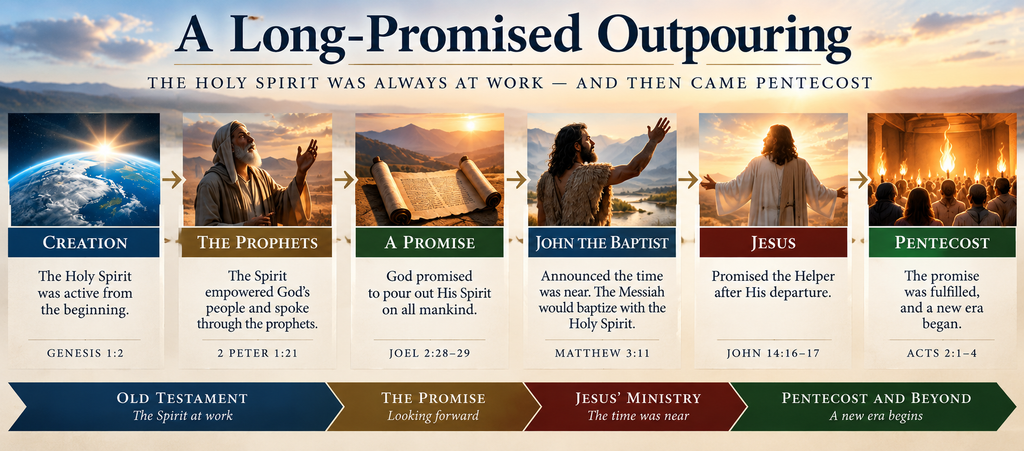
The Holy Spirit did not suddenly appear for the first time on the Day of Pentecost. He was present at creation. He spoke through the prophets. He empowered people to accomplish God’s purposes. David prayed that God would not take His Holy Spirit from him. The Spirit was active throughout the Old Testament and throughout the earthly ministry of Jesus.
And yet, both the Old Testament prophets and Jesus spoke about something that was still coming. God promised a day when He would pour out His Spirit in a new and extraordinary way. Jesus told His apostles to wait in Jerusalem until that promise was fulfilled.
Then, on the Day of Pentecost, everything changed.
To understand what happened in Acts 2, we need to begin much earlier. Pentecost was the fulfillment of a promise God had been making for centuries.
The Holy Spirit Was Already at Work
Sometimes Christians speak as though the Holy Spirit was essentially absent during the Old Testament and arrived on earth at Pentecost. But Scripture paints a very different picture.
The Spirit appears in the opening verses of the Bible:
“The earth was formless and void, and darkness was over the surface of the deep, and the Spirit of God was moving over the surface of the waters.” (Genesis 1:2)
Throughout the Old Testament, we see the Spirit working in the lives of God’s people. The Spirit came upon individuals and empowered them for particular tasks. He gave wisdom and skill to Bezalel for the construction of the tabernacle (Exodus 31:1 – 5). He empowered judges such as Gideon and Samson (Judges 6:34; 14:6). He came upon David when Samuel anointed him as king (1 Samuel 16:13). He also worked through the prophets as they delivered God’s message.
Peter later summarized the work of the Spirit through those prophets:
“For no prophecy was ever made by an act of human will, but men moved by the Holy Spirit spoke from God.” (2 Peter 1:21)
Clearly, the Holy Spirit was active long before Pentecost. So when Scripture promises that God will “pour out” His Spirit, it cannot mean that the Spirit had never been present before. Something different was being promised.
A Promise of Something Greater
Several Old Testament prophets looked forward to a time when God’s relationship with His people would change in a significant way. Rather than the Spirit coming upon particular individuals for particular purposes, God’s Spirit would be given to His people in a much broader and more personal way.
Ezekiel records one of the most remarkable promises:
“Moreover, I will give you a new heart and put a new spirit within you… I will put My Spirit within you and cause you to walk in My statutes.” (Ezekiel 36:26 – 27)
This was something more than temporary empowerment for a judge, king, prophet, or craftsman. God promised to put His Spirit within His people. The promise was connected with inward transformation, obedience, and a new relationship with God.
Jeremiah described this coming era as a new covenant:
“I will put My law within them and on their heart I will write it; and I will be their God, and they shall be My people.” (Jeremiah 31:33)
The prophets were pointing forward to a time when God’s work would reach deeply into the hearts of His people.
Joel Promised an Outpouring
The prophet Joel described the coming of the Spirit using the language that would later become central to the events of Pentecost:
“It will come about after this that I will pour out My Spirit on all mankind; and your sons and daughters will prophesy, your old men will dream dreams, your young men will see visions. Even on the male and female servants I will pour out My Spirit in those days.” (Joel 2:28 – 29)
The scope of this promise is striking. God’s Spirit would not be limited to prophets, priests, kings, or specially chosen leaders. Joel mentions sons and daughters, old and young, male and female servants. The language points toward a dramatic expansion in the availability of the Spirit.
That does not mean every person on earth would automatically receive the Holy Spirit. As the New Testament unfolds, it becomes clear that the promise is connected with those who respond to God in faith. But Joel’s language shows that the coming gift would cross the social and demographic boundaries that might otherwise have seemed important.
God was preparing to pour out His Spirit upon His people in an unprecedented way.
John the Baptist Announced That the Time Was Near
Centuries later, John the Baptist appeared in the wilderness announcing that the Messiah was coming. John’s ministry included water baptism, but he told the people that the One coming after him would do something far greater:
“As for me, I baptize you with water for repentance, but He who is coming after me is mightier than I… He will baptize you with the Holy Spirit and fire.” (Matthew 3:11)
The promised outpouring of the Spirit was now connected directly with Jesus. The prophets had said God would pour out His Spirit. John announced that the Messiah would be the One through whom this promise would be fulfilled.
Jesus’ ministry confirmed that the promised age was drawing near. The Holy Spirit descended upon Him at His baptism. Jesus performed His ministry in the power of the Spirit. Yet Jesus continued to speak of the Spirit as a gift His followers would receive in a new way after His departure.
Jesus Promised the Spirit
On the night before His crucifixion, Jesus spoke extensively with His apostles about what would happen after He left them. Understandably, they were troubled. They had spent years following Him. Now He was telling them that He was going away.
But Jesus promised that they would not be abandoned:
“I will ask the Father, and He will give you another Helper, that He may be with you forever.” (John 14:16)
Jesus then identified this Helper:
“But the Helper, the Holy Spirit, whom the Father will send in My name, He will teach you all things…” (John 14:26)
Jesus even told the apostles that His departure would ultimately be to their advantage because it would lead to the coming of the Helper (John 16:7).
Think about how remarkable that statement is. The apostles had lived with Jesus. They had walked with Him, listened to Him teach, watched Him perform miracles, and shared meals with Him. Yet Jesus said there was an important reason for Him to leave. God’s plan included sending the Holy Spirit to continue His work among and within His people.
Wait for the Promise
After His resurrection, Jesus spent forty days with His apostles. Just before His ascension, He returned to the promise of the Spirit and gave them very specific instructions:
“He commanded them not to leave Jerusalem, but to wait for what the Father had promised, ‘Which,’ He said, ‘you heard of from Me; for John baptized with water, but you will be baptized with the Holy Spirit not many days from now.’” (Acts 1:4 – 5)
Jesus then explained what would happen when the Spirit came:
“But you will receive power when the Holy Spirit has come upon you; and you shall be My witnesses…” (Acts 1:8)
The apostles were not told to begin their worldwide mission immediately. They were told to wait. Something decisive was about to happen, and their mission would begin only after they had received what the Father had promised.
The Promise Was Fulfilled at Pentecost
Not many days later, the apostles and other disciples were gathered in Jerusalem for the Jewish Feast of Pentecost. Acts describes what happened:
“And suddenly there came from heaven a noise like a violent rushing wind, and it filled the whole house where they were sitting. And there appeared to them tongues as of fire distributing themselves, and they rested on each one of them. And they were all filled with the Holy Spirit…” (Acts 2:2 – 4)
The apostles began speaking in languages they had not learned. Jews from many different nations were in Jerusalem, and they heard the message being proclaimed in their own languages. The crowd was astonished and wanted to know what was happening.
Peter stood up and explained it by pointing directly to Joel’s prophecy:
“But this is what was spoken of through the prophet Joel: ‘And it shall be in the last days,’ God says, ‘That I will pour forth of My Spirit on all mankind…’” (Acts 2:16 – 17)
Peter’s explanation is crucial. Pentecost was not an isolated spiritual experience with no larger meaning. It was the fulfillment of God’s ancient promise. The age the prophets had anticipated had arrived.
What Does “Poured Out” Mean?
The image of pouring communicates abundance. God was not reluctantly giving tiny portions of His Spirit to a select few. A new era had begun in which the Holy Spirit would be available to God’s people in a way that crossed boundaries of age, sex, social status, and eventually nationality.
This becomes increasingly clear as the book of Acts continues. The Spirit is poured out upon Jewish believers in Jerusalem. Later, Samaritans receive the Spirit. Then Gentiles receive the Spirit in the household of Cornelius. The gospel moves outward, just as Jesus had said, from Jerusalem to Judea and Samaria and ultimately toward the ends of the earth.
What began at Pentecost would not remain confined to the apostles or to Jerusalem.
Peter made that clear on the very day the Spirit was poured out.
The Promise Was Not Just for the Apostles
After Peter preached the death and resurrection of Jesus, the people were deeply convicted and asked what they should do. Peter responded:
“Repent, and each of you be baptized in the name of Jesus Christ for the forgiveness of your sins; and you will receive the gift of the Holy Spirit.” (Acts 2:38)
Then he immediately broadened the promise:
“For the promise is for you and your children and for all who are far off, as many as the Lord our God will call to Himself.” (Acts 2:39)
This is one of the most important statements in the entire discussion. The Holy Spirit was not simply a special gift for the apostles. The promise extended beyond them, beyond the people standing in Jerusalem, and ultimately beyond the Jewish nation.
God was beginning something much larger.
A New Era in God’s Relationship With His People
The outpouring of the Holy Spirit marks one of the great turning points in the biblical story. The Spirit had always been active, but God had promised something greater. He promised to put His Spirit within His people. He promised to pour out His Spirit broadly. Jesus promised the Helper who would remain with His followers. And at Pentecost, those promises began to be fulfilled.
This helps us avoid two opposite mistakes. We should not imagine that the Holy Spirit was absent before Acts 2. He clearly was not. But neither should we treat Pentecost as though nothing fundamentally important changed. The prophets, John the Baptist, Jesus, and Peter all present the coming of the Spirit as the beginning of something new.
The Holy Spirit would now occupy a central place in the life of God’s new covenant people. He would dwell within them, transform them, unite them, empower their witness, and mark them as belonging to God.
But the events of Pentecost raise several questions. Why the rushing wind? Why the tongues of fire? Why did the apostles suddenly speak in other languages? And why did Peter immediately connect all of this with the death, resurrection, and exaltation of Jesus?
That is where we turn next: What Really Happened at Pentecost?
Want to Go Deeper?
This article is adapted from my book, Understanding the Holy Spirit: A Scriptural Study Guide. If you’d like to explore the Holy Spirit in greater depth, including His indwelling presence, His work in our lives, the fruit of the Spirit, being filled with the Spirit, spiritual gifts, and much more, the complete study is available on Amazon.