

Have you ever found yourself praying but struggling to find the right words? Perhaps you were facing a difficult decision, grieving a loss, or dealing with circumstances so complicated that you did not even know what to ask God to do.
Most Christians have experienced moments like these. We know that prayer is important, and we want to approach God faithfully, but sometimes our understanding is limited and our words seem inadequate.
Fortunately, Scripture reveals something extraordinary about the Holy Spirit’s work in our prayers. God has not left us entirely dependent upon our own ability to understand every situation or express every need correctly. The Holy Spirit Himself helps us in our weakness.
Paul explains this remarkable truth in Romans 8, and his words offer both comfort and a deeper understanding of the Spirit’s ministry in the lives of believers.
The Spirit Helps Us in Our Weakness
Paul writes:
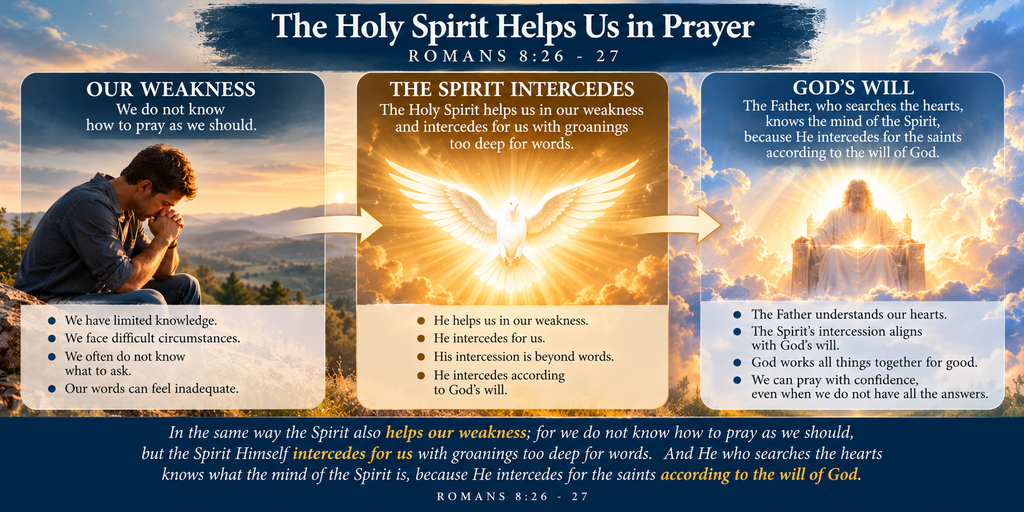
“In the same way the Spirit also helps our weakness; for we do not know how to pray as we should, but the Spirit Himself intercedes for us with groanings too deep for words.” (Romans 8:26)

Notice that Paul does not say Christians occasionally need help because they have failed to pray correctly. He describes weakness as part of our present human condition. Even faithful believers do not always know what to pray for as they should.
We have limited knowledge. We cannot see the future, understand every consequence, or know with certainty which outcome will ultimately accomplish God’s purposes. Something that appears desirable today may prove harmful tomorrow. A difficult experience we desperately want to escape may become an occasion for spiritual growth.
That does not mean we should stop praying or become afraid of asking God for what we believe we need. Rather, Paul reminds us that our limitations do not prevent God from understanding us or caring for us.
The Spirit helps us precisely because we are weak.
Understanding the Context of Romans 8
To understand what Paul means, we should look at the surrounding passage. Romans 8 describes the Christian’s present struggle between suffering and the glorious future God has promised. Paul explains that creation itself is suffering under the effects of sin and corruption:
“For we know that the whole creation groans and suffers the pains of childbirth together until now.” (Romans 8:22)
He then describes Christians as sharing in that longing:
“And not only this, but also we ourselves, having the first fruits of the Spirit, even we ourselves groan within ourselves, waiting eagerly for our adoption as sons, the redemption of our body.” (Romans 8:23)
Notice the progression. Creation groans. Believers groan. Then, in verse 26, Paul speaks of the Spirit’s intercession with groanings too deep for words. These statements belong together. Paul is describing life in a world that has not yet experienced its final redemption. Christians have received the Holy Spirit, but they still experience weakness, suffering, uncertainty, and longing.
It is within this setting that the Spirit helps us in prayer.
What Does It Mean That the Spirit Intercedes?
The word intercede means to act or appeal on behalf of someone else. In Romans 8:26, Paul tells us that the Holy Spirit intercedes for believers. This is a remarkable statement because it means our prayers are not limited to what we can personally understand or express.
Imagine a Christian praying for a loved one who is seriously ill. The natural desire is for that person to recover, and there is nothing wrong with asking God for healing. Yet we cannot know every aspect of God’s providence or every consequence of the situation.
Or consider someone facing a difficult decision. They may sincerely pray for one particular outcome, believing it to be best, while recognizing that their knowledge is incomplete. Paul’s teaching reminds us that the Spirit’s intercession is not hindered by those limitations.
We should not imagine that the Holy Spirit is correcting our prayers because God is reluctant to listen or because we have failed to use the right words. The Father already knows our needs, and the Spirit’s intercession is part of God’s gracious provision for His people.
What Are the Groanings Too Deep for Words?
One of the most discussed phrases in Romans 8:26 is Paul’s statement that the Spirit intercedes “with groanings too deep for words.”
What exactly are these groanings?
Some understand them as the Spirit’s own inexpressible intercession on behalf of believers. Others understand the Spirit as participating in or giving expression to the deep longings of Christians who cannot adequately articulate their prayers. The wording has generated discussion because Paul does not provide a detailed explanation of the mechanism involved. However, there are several things we can say with confidence.
First, the passage explicitly identifies the Holy Spirit as the one who intercedes. Second, the intercession occurs in the context of human weakness. Third, Paul describes the groanings as beyond words or inexpressible. And fourth, the following verse tells us that this intercession is according to the will of God.
Those points are clear even if the precise nature of the groanings remains difficult to explain.
Is Paul Talking About Speaking in Tongues?
Some Christians interpret Romans 8:26 as a reference to praying in tongues. They suggest that the Spirit provides a supernatural prayer language when believers do not know what to say. But we should be careful about reading that idea into the passage.
Paul does not mention tongues in Romans 8:26 – 27. He does not describe believers speaking in another language, nor does he instruct them to seek a particular spiritual gift. Instead, he describes the Spirit Himself interceding for Christians in their weakness.
The context is also important. Paul is addressing the shared experience of believers who live in a fallen world and await their final redemption. His statement about weakness applies broadly to Christians, not merely to those who possess a particular miraculous gift. In 1 Corinthians 12, Paul makes clear that not all Christians possess the same spiritual gifts. He specifically asks:
“All do not speak with tongues, do they?” (1 Corinthians 12:30)
The expected answer is no. It would therefore be difficult to make speaking in tongues a necessary part of the Spirit’s intercession for every Christian. Romans 8 offers something much broader and more reassuring. The Holy Spirit helps believers in their weakness, whether or not they possess any particular spiritual gift.
The Spirit Intercedes According to God’s Will
Paul continues:
“And He who searches the hearts knows what the mind of the Spirit is, because He intercedes for the saints according to the will of God.” (Romans 8:27)
This verse gives us an important insight into the Spirit’s intercession. It is always in harmony with God’s will.
Our prayers, however sincere, are sometimes shaped by incomplete knowledge. We may ask for something that seems beneficial without understanding all the circumstances involved. We may pray for relief from a difficulty that God can use for our spiritual growth. The Spirit does not share our limitations. His intercession is perfectly consistent with God’s purposes.
That should give us great confidence. We do not need to understand everything before approaching God in prayer. We can bring our needs, fears, hopes, and concerns to Him while trusting that the Spirit’s intercession is fully aligned with the Father’s will.
Jesus Also Intercedes for Us
Interestingly, Romans 8 describes not only the Holy Spirit’s intercession but also the intercession of Jesus Christ.
A few verses later, Paul writes:
“Christ Jesus is He who died, yes, rather who was raised, who is at the right hand of God, who also intercedes for us.” (Romans 8:34)
Hebrews makes a similar statement:
“Therefore He is able also to save forever those who draw near to God through Him, since He always lives to make intercession for them.” (Hebrews 7:25)
Both the Son and the Spirit are described as interceding for God’s people, although Scripture does not describe their roles in exactly the same way. Jesus is our risen Savior and great High Priest, whose sacrificial work provides the basis for our access to God. The Holy Spirit helps us in our weakness and intercedes according to God’s will.
We should not imagine these as competing ministries or as evidence that the Father is unwilling to hear us. The Father, Son, and Holy Spirit are united in God’s gracious work for our salvation.
Does This Mean We Do Not Need to Pray Carefully?
If the Holy Spirit intercedes for us, someone might wonder whether it matters how we pray. After all, if the Spirit helps us in our weakness, why should we make an effort to understand God’s will or express our requests thoughtfully? But Scripture never uses the Spirit’s intercession as an excuse for careless prayer.
Jesus taught His disciples to pray with reverence, trust, and submission to the Father. In the Lord’s Prayer, He included the words:
“Your kingdom come. Your will be done, on earth as it is in heaven.” (Matthew 6:10)
Paul also encouraged Christians to pray regularly and thankfully:
“Devote yourselves to prayer, keeping alert in it with an attitude of thanksgiving.” (Colossians 4:2)
The Spirit’s help does not replace our responsibility to pray. Instead, it gives us confidence as we do so. We should seek to pray according to God’s revealed will, bring our requests before Him honestly, and remain willing to accept His wisdom when His answer differs from what we hoped.
Prayer Does Not Require Perfect Words
One of the most encouraging implications of Romans 8 is that effective prayer does not depend upon eloquence.
Some Christians feel uncomfortable praying aloud because they believe they lack the right vocabulary. Others worry that their prayers are too simple or repetitive. Still others struggle to pray during times of intense grief or emotional exhaustion. But God is not impressed by elaborate language, and He is not confused by simple prayers.
Jesus warned against praying merely to impress others or assuming that many words make prayer more effective (Matthew 6:5 – 8). He reminded His followers that the Father knows what they need even before they ask. Romans 8 adds another dimension to that assurance. Even when we do not know how to pray as we should, the Holy Spirit helps us.
We can approach God honestly, without pretending to possess greater wisdom or spiritual maturity than we actually have.
Prayer During Suffering and Uncertainty
The connection between the Spirit’s intercession and the suffering described in Romans 8 is particularly meaningful.
Christians are not promised a life free from difficulty. We experience illness, disappointment, loss, uncertainty, and the consequences of living in a fallen world. Sometimes those circumstances are so overwhelming that we struggle even to identify what we should ask God to do. Paul’s teaching assures us that our weakness does not separate us from God’s care.
In fact, immediately after describing the Spirit’s intercession, Paul writes:
“And we know that God causes all things to work together for good to those who love God, to those who are called according to His purpose.” (Romans 8:28)
This familiar verse is often quoted by itself, but its placement is significant. It follows Paul’s discussion of suffering, hope, weakness, and the Spirit’s intercession. Paul is not promising that every event will be pleasant or that every prayer will be answered exactly as we request. He is assuring believers that God is at work according to His purposes, even in circumstances we do not fully understand.
The following verse identifies the ultimate direction of that purpose: being conformed to the image of His Son (Romans 8:29). The Spirit’s intercession belongs within that larger picture of God’s work in our lives.
What Should We Remember When We Pray?
Romans 8 gives Christians several important reasons for confidence in prayer.
We should remember that God understands our weakness. We are not expected to possess perfect knowledge of every circumstance or to know precisely what outcome will be best. We should also remember that the Holy Spirit helps us and intercedes according to God’s will.
At the same time, we should continue to pray faithfully, seeking God’s wisdom and submitting our requests to His purposes. Prayer is not an attempt to persuade God to abandon His wisdom in favor of ours. It is an expression of dependence upon the Father who loves us.
When we understand these truths, prayer becomes less about finding the perfect words and more about approaching God with faith, humility, and trust.
We Are Never Alone in Prayer
The Holy Spirit’s intercession is one of the most comforting aspects of His indwelling presence. There will be times when we know exactly what we want to ask God. There will also be times when our circumstances are confusing, our emotions are overwhelming, and our understanding is painfully limited. But even in those moments, we are not left to ourselves.
The Holy Spirit helps us in our weakness. He intercedes according to the will of God. And Jesus Christ, our risen Savior, also intercedes for us. Our prayers may be imperfect, but God’s provision for us is not.
In our next article, we will consider another important aspect of our relationship with the indwelling Spirit: Can We Grieve or Quench the Holy Spirit?
Want to Go Deeper?
This article is adapted from my book, Understanding the Holy Spirit: A Scriptural Study Guide. If you’d like to explore the Holy Spirit in greater depth, including His indwelling presence, His work in our lives, the fruit of the Spirit, being filled with the Spirit, spiritual gifts, and much more, the complete study is available on Amazon.