

One of the most remarkable truths about the Christian life is that the Holy Spirit dwells within God’s people. As we have seen in earlier articles, His presence identifies us as belonging to Christ, and He helps us in our weakness, strengthens us spiritually, and works to transform our character.
But the New Testament also contains some sobering warnings about our relationship with the Holy Spirit. Paul tells Christians not to grieve the Spirit, and elsewhere he warns them not to quench Him. What do these expressions mean? Can our behavior actually affect the Holy Spirit? Can we resist or interfere with His work? And what should Christians do to avoid these dangers?
To answer those questions, we need to examine the two passages carefully. Although the expressions are related, they occur in different contexts and should not automatically be treated as interchangeable.

What Does It Mean to Grieve the Holy Spirit?
Paul writes to the Christians in Ephesus:
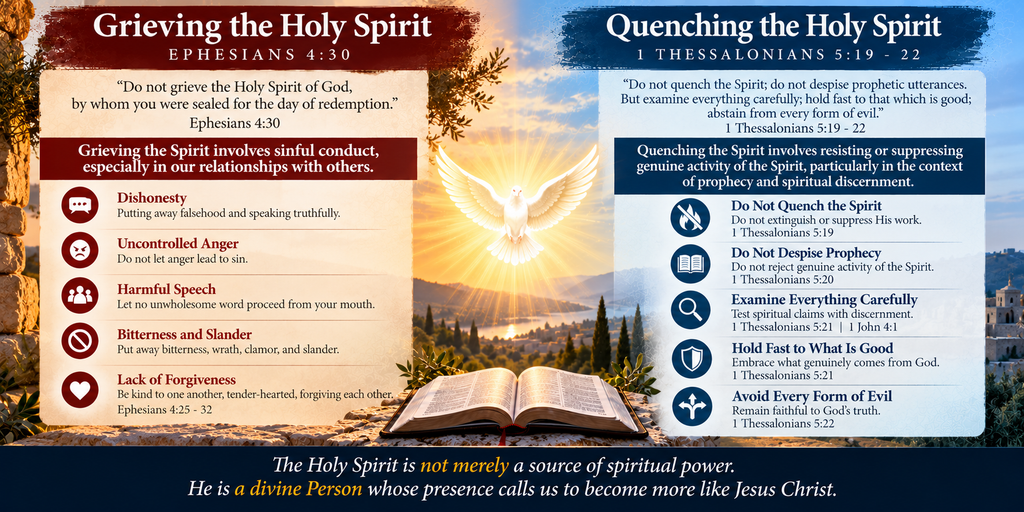
“Do not grieve the Holy Spirit of God, by whom you were sealed for the day of redemption.” (Ephesians 4:30)
The word translated grieve comes from the Greek verb lypeō, which means to cause sorrow, distress, or grief. The expression is significant because it reinforces something we established earlier in this series: the Holy Spirit is not merely an impersonal force or spiritual energy. He is a divine Person.
We do not ordinarily speak of grieving an impersonal power. Grief is associated with personal relationships. Paul’s warning therefore reminds us that the Holy Spirit’s presence within Christians is not simply a theological abstraction. Our conduct matters in our relationship with Him.But what kinds of behavior does Paul have in mind?
The Context of Ephesians 4
One of the most important principles of biblical interpretation is to read a verse in its context. Ephesians 4:30 is no exception.
Beginning in Ephesians 4:17, Paul urges Christians to stop living as they did before coming to Christ. He contrasts their former way of life with the new life they have received. He instructs them to lay aside the old self and put on the new self, which has been created in righteousness and holiness (Ephesians 4:22 – 24).
Then he becomes very practical. He tells believers to put away falsehood and speak truthfully to one another. He warns against allowing anger to lead to sin. He instructs those who have stolen to stop stealing and instead work honestly so they can share with others.
He also addresses the way Christians speak:
“Let no unwholesome word proceed from your mouth, but only such a word as is good for edification according to the need of the moment, so that it will give grace to those who hear.” (Ephesians 4:29)
Immediately after these instructions comes the warning not to grieve the Holy Spirit.
Paul then continues:
“Let all bitterness and wrath and anger and clamor and slander be put away from you, along with all malice. Be kind to one another, tender-hearted, forgiving each other, just as God in Christ also has forgiven you.” (Ephesians 4:31 – 32)
The connection is unmistakable. Paul is discussing the everyday conduct of Christians, particularly how they treat one another.
Our Treatment of Others Matters to the Spirit
Sometimes Christians think primarily about dramatic or obviously immoral behavior when considering what might grieve the Holy Spirit. But Paul’s examples include ordinary attitudes and actions that can become common even among religious people. Dishonesty, uncontrolled anger, bitterness, harsh speech, slander, and unwillingness to forgive are all included in the surrounding discussion.
That should cause us to examine ourselves carefully. A Christian may be diligent in Bible study, regular in worship, and outspoken about defending biblical truth, yet still harbor resentment, speak cruelly to others, or refuse to forgive. Paul’s warning reminds us that the Spirit’s work is deeply connected with the character of Christ. The same Spirit who produces love, kindness, patience, gentleness, and self-control is grieved when believers embrace attitudes and behaviors that contradict those qualities.
We cannot separate our relationship with the Holy Spirit from our relationship with others.
Why Does Paul Mention Being Sealed?
There is another important detail in Ephesians 4:30. Paul identifies the Holy Spirit as the one by whom believers were sealed for the day of redemption.
Earlier in the letter, he wrote:
“In Him, you also, after listening to the message of truth, the gospel of your salvation – having also believed, you were sealed in Him with the Holy Spirit of promise.” (Ephesians 1:13)
The seal identifies believers as belonging to God and points toward the redemption He has promised. Why would Paul mention that here? Because the Holy Spirit’s presence makes sinful conduct especially serious. The Spirit is not a stranger to Christians. He is God’s gift to His people, marking them as belonging to Christ.
Paul’s warning is therefore grounded in the privilege of our relationship with God. Because we belong to Him, we should live in a manner consistent with that relationship.
Does Grieving the Spirit Mean He Leaves Us?
Some Christians worry that every sin causes the Holy Spirit to depart from them. Others believe that grieving the Spirit means losing salvation immediately.
But Ephesians 4:30 does not make either statement. Paul warns believers not to grieve the Spirit while simultaneously reminding them that they have been sealed for the day of redemption. His purpose is to call them to holiness, not to explain that the Spirit abandons them whenever they fail.
This does not mean sin is harmless or that Christians should become complacent. The New Testament contains serious warnings about persistent rebellion, unbelief, and turning away from Christ. But we should not make Ephesians 4:30 say more than it actually says. The passage teaches that sinful conduct grieves the Holy Spirit. It does not establish a formula describing the Spirit departing from a believer.
The appropriate response is repentance, renewed obedience, and a commitment to live consistently with our identity in Christ.
What Does It Mean to Quench the Spirit?
Paul gives another instruction in his first letter to the Thessalonians:
“Do not quench the Spirit.” (1 Thessalonians 5:19)
The Greek verb translated quench is sbennymi, commonly used for extinguishing or putting out a fire. The imagery is vivid. Just as water can extinguish a flame, something can suppress or hinder the activity of the Spirit. But before we decide exactly what Paul means, we need to look at the surrounding context.
The Context of 1 Thessalonians 5
Paul writes:
“Do not quench the Spirit; do not despise prophetic utterances. But examine everything carefully; hold fast to that which is good; abstain from every form of evil.” (1 Thessalonians 5:19 – 22)
Notice how closely these instructions are connected. Paul warns against quenching the Spirit and immediately tells the Thessalonians not to despise prophecies. He then instructs them to examine everything carefully and hold fast to what is good. This suggests that Paul’s warning was particularly concerned with the way the congregation responded to spiritual activity, including prophetic messages.
In the early church, miraculous spiritual gifts were part of congregational life. Prophecy was among those gifts, and Paul gave instructions about its proper exercise in passages such as 1 Corinthians 12 – 14. Apparently, some believers could respond to such activity by dismissing it altogether. Paul warned against that reaction. But he also warned against the opposite extreme.
Do Not Despise Prophecy, but Test Everything
Paul’s instructions contain an important balance. He tells the Thessalonians not to despise prophetic utterances, but he does not tell them to accept every claimed prophecy without question.
Instead, he says:
“But examine everything carefully; hold fast to that which is good.” (1 Thessalonians 5:21)
That distinction is essential. The early Christians were not supposed to reject genuine activity of the Holy Spirit, but neither were they supposed to accept every spiritual claim simply because someone said it came from God.
John gives a similar warning:
“Beloved, do not believe every spirit, but test the spirits to see whether they are from God, because many false prophets have gone out into the world.” (1 John 4:1)
Testing spiritual claims is not evidence of unbelief. Scripture itself commands discernment. The challenge is to avoid both extremes: rejecting what genuinely comes from God and accepting what does not.
Does Quenching the Spirit Apply to Christians Today?
This question requires careful consideration because Christians disagree about whether the miraculous gifts described in the New Testament continue in the same way today. Some believe gifts such as prophecy and tongues remain active in the church. Others believe those miraculous gifts served particular purposes during the foundational period of the church and are no longer exercised in the same way. We will examine those questions more fully when we reach the section on spiritual gifts.
For now, the immediate context of 1 Thessalonians 5:19 should guide our interpretation. Paul was warning Christians against suppressing genuine activity of the Spirit, particularly in connection with prophecy.
We can certainly recognize a broader principle: Christians should not resist God’s revealed will or reject what genuinely comes from Him. But we should distinguish that general application from the specific situation Paul was addressing.
It would be a mistake to use this verse as proof that every spiritual impression, emotional experience, or modern claim of prophecy must be accepted. Paul’s very next instruction is to test everything carefully.
Grieving and Quenching Are Not Exactly the Same
Now that we have examined both passages, we can see an important distinction.
In Ephesians 4, grieving the Spirit is connected with sinful conduct, particularly behavior that contradicts the new life Christians have received in Christ. In 1 Thessalonians 5, quenching the Spirit appears in a context involving prophecy – or people speaking on behalf of God, discernment, and the congregation’s response to spiritual activity.
Both passages warn Christians against conduct that is inconsistent with the Spirit’s work, but they approach the subject from different directions. Grieving emphasizes the personal nature of the Spirit and the seriousness of sinful behavior. Quenching emphasizes the danger of suppressing or rejecting genuine activity of the Spirit.
Keeping these contexts distinct helps us understand Paul’s instructions more accurately.
Can We Resist the Holy Spirit?
Scripture also speaks about resisting the Holy Spirit. Stephen accused his opponents of doing precisely that:
“You men who are stiff-necked and uncircumcised in heart and ears are always resisting the Holy Spirit; you are doing just as your fathers did.” (Acts 7:51)
Stephen was addressing Jewish leaders who had rejected God’s messengers and ultimately resisted the message concerning Jesus Christ. The broader lesson is sobering. Human beings can resist what God reveals and refuse to respond faithfully to His will.
But again, we should not assume that resisting, grieving, and quenching are identical expressions. Each passage has its own setting and emphasis. What they share is the warning that people are responsible for how they respond to God’s Spirit and His revealed truth.
How Can We Avoid Grieving the Spirit?
Paul’s instructions in Ephesians 4 provide a straightforward answer. We should put away sinful behavior and pursue the character of Christ. That means speaking truthfully, controlling anger, refusing to harbor bitterness, using our words to encourage rather than destroy, and practicing kindness and forgiveness.
These are not merely good social habits. They reflect the transformation God intends to accomplish in His people. Paul’s concluding instruction is especially meaningful:
“Be kind to one another, tender-hearted, forgiving each other, just as God in Christ also has forgiven you.” (Ephesians 4:32)
When Christians practice these qualities, they are living consistently with the Spirit’s work rather than grieving Him through conduct that contradicts it.
How Can We Avoid Quenching the Spirit?
The answer from 1 Thessalonians 5 is equally important. We should receive what genuinely comes from God while carefully examining spiritual claims. That means respecting the authority of Scripture, refusing to dismiss God’s truth simply because it challenges our preferences, and exercising discernment rather than accepting every religious claim uncritically.
We should not confuse skepticism with wisdom or emotional enthusiasm with spirituality. The biblical approach is to test what we hear and hold fast to what is good. For Christians today, that requires a serious commitment to understanding and obeying God’s revealed Word.
A Relationship That Calls for Holiness
The warnings against grieving and quenching the Holy Spirit remind us that His presence in our lives is both a blessing and a responsibility. God has given His Spirit to dwell within His people. He strengthens us, helps us in weakness, and works to transform our character. But we must not treat that relationship casually.
Our attitudes, words, and actions matter. So does our response to God’s truth. We should therefore pursue holiness, practice discernment, and seek to live consistently with the Spirit’s work in our lives.
The Holy Spirit is not merely a source of spiritual power. He is a divine Person whose presence calls us to become more like Jesus Christ.
In our next article, we will examine a related question: How Can We Recognize the Holy Spirit’s Work in Our Lives?
Want to Go Deeper?
This article is adapted from my book, Understanding the Holy Spirit: A Scriptural Study Guide. If you’d like to explore the Holy Spirit in greater depth, including His indwelling presence, His work in our lives, the fruit of the Spirit, being filled with the Spirit, spiritual gifts, and much more, the complete study is available on Amazon.