

Is there a spiritual world beyond the physical universe we can see and measure? Are angels and demons real? What about Satan? And how does the Holy Spirit relate to this unseen realm?
These questions have fascinated people for thousands of years. Throughout history, cultures have developed elaborate beliefs about spirits, supernatural forces, angels, demons, and life beyond the physical world. Today, books, movies, television programs, and social media continue to shape popular ideas about the supernatural.
But Christians approach these questions differently. Our understanding of the spiritual world comes primarily from what God has revealed in Scripture, not from speculation, personal experiences, or popular entertainment.
The Bible clearly teaches that reality includes more than the physical universe. Yet it also places important limits on what we can know about the unseen realm. Understanding both what Scripture reveals and what it leaves unexplained will help us avoid confusion and keep our attention where it belongs.
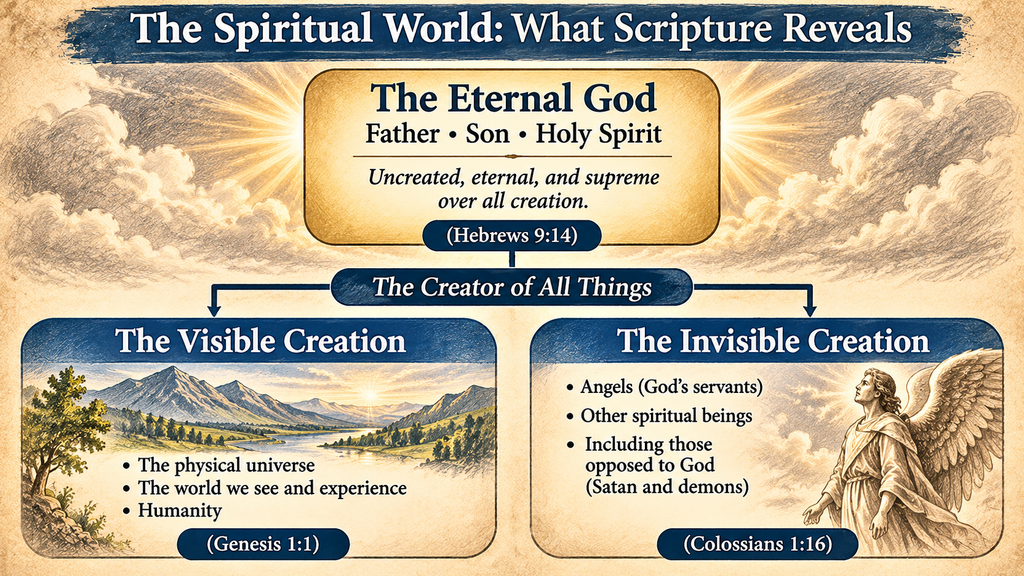
God Created Both Visible and Invisible Things
One of the clearest statements about the spiritual world appears in Paul’s letter to the Colossians:
“For by Him all things were created, both in the heavens and on earth, visible and invisible, whether thrones or dominions or rulers or authorities – all things have been created through Him and for Him.” (Colossians 1:16)
Paul is describing the supremacy of Jesus Christ over all creation. His statement includes not only the visible universe but also invisible realities, including spiritual authorities and powers.
This passage establishes an important truth: the unseen spiritual realm is not independent of God. Whatever created spiritual beings exist, they owe their existence to Him. The spiritual world is therefore not an alternative universe governed by powers equal to God. It is part of the creation over which Christ is supreme.
Paul continues:
“He is before all things, and in Him all things hold together.” (Colossians 1:17)
The entire created order, visible and invisible, exists under Christ’s authority.
The Holy Spirit Is Not a Created Spirit
Before discussing angels, demons, and other spiritual beings, we need to make an essential distinction. The Holy Spirit is not simply one spirit among many. As we established in the opening articles of this series, the Holy Spirit is divine. He possesses the attributes of God and participates in the works of God.
Scripture describes Him as eternal:
“How much more will the blood of Christ, who through the eternal Spirit offered Himself without blemish to God, cleanse your conscience from dead works to serve the living God?” (Hebrews 9:14)
The Spirit is also present in the biblical account of creation:
“The earth was formless and void, and darkness was over the surface of the deep, and the Spirit of God was moving over the surface of the waters.” (Genesis 1:2)
Angels and other spiritual beings belong to the created order. The Holy Spirit does not. He is eternal God, existing with the Father and the Son. This distinction matters because the word spirit can refer to different things in Scripture. It may refer to the Holy Spirit, created spiritual beings, or aspects of human existence. We must allow the context to determine its meaning.
We should never confuse the Holy Spirit with an angel, an impersonal supernatural force, or some lesser spiritual power.
Angels Are Real Spiritual Beings
The Bible repeatedly describes angels as real beings who serve God and carry out His purposes.
The writer of Hebrews asks:
“Are they not all ministering spirits, sent out to render service for the sake of those who will inherit salvation?” (Hebrews 1:14)
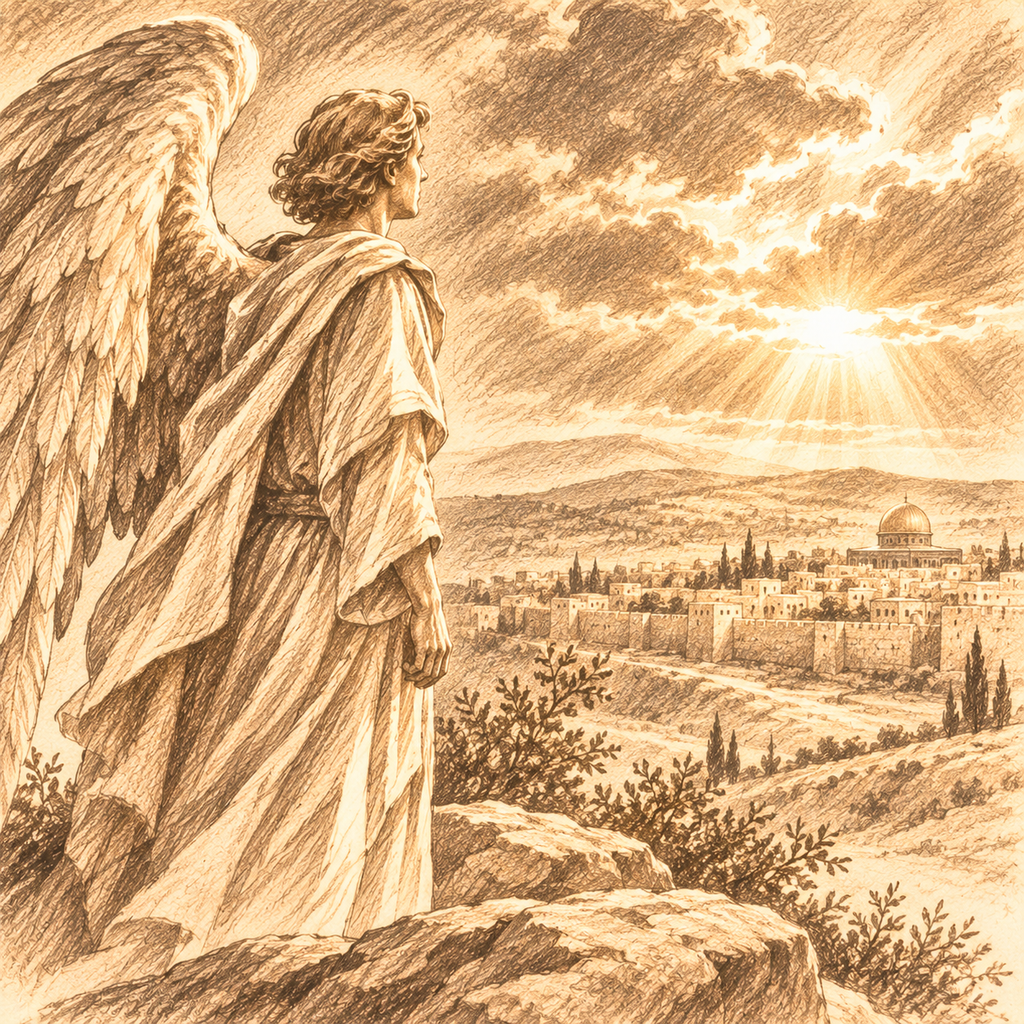
This passage describes angels as ministering spirits. They are servants of God, not independent divine beings. Throughout Scripture, angels appear in connection with important events. An angel announced the coming birth of John the Baptist to Zechariah (Luke 1:11 – 20). Gabriel announced to Mary that she would give birth to Jesus (Luke 1:26 – 38). Angels announced the resurrection of Jesus to the women who visited His tomb (Luke 24:1 – 7).
These accounts show angels carrying out God’s purposes, often by delivering messages or providing assistance. But Scripture never presents angels as objects of Christian worship. Their role is subordinate to God.
Not Everything Spiritual Is Good
The Bible also teaches that some spiritual beings are opposed to God and His purposes. Jesus spoke about Satan and demons as real personal beings. During His earthly ministry, He confronted demonic activity and demonstrated authority over evil spirits.
For example, Mark records:
“And He healed many who were ill with various diseases, and cast out many demons; and He was not permitting the demons to speak, because they knew who He was.” (Mark 1:34)
The New Testament also identifies Satan as an adversary who opposes God’s people.
Peter warns:
“Be of sober spirit, be on the alert. Your adversary, the devil, prowls around like a roaring lion, seeking someone to devour.” (1 Peter 5:8)
These passages make clear that the Bible does not treat every spiritual influence as good or trustworthy. At the same time, we should avoid imagining Satan as a rival deity possessing power equal to God’s. Satan is a created being, not an eternal counterpart to the Lord.
God Is Supreme Over the Spiritual World
One of the most important truths Christians should remember is that the spiritual world is not a battlefield between two equally powerful gods. God is the Creator. Satan and the demons are creatures. Whatever power they possess is limited and subordinate to God’s ultimate authority. The New Testament emphasizes the supremacy of Jesus Christ over every spiritual authority.
Paul writes:
“He is the head over all rule and authority.” (Colossians 2:10)
He also describes Christ’s exaltation:
“Far above all rule and authority and power and dominion, and every name that is named, not only in this age but also in the one to come.” (Ephesians 1:21)
This should shape the Christian’s understanding of spiritual conflict. Evil spiritual beings may be real, but they are not equal to God. Christ’s authority is supreme.
Can We See or Detect the Spiritual World?
By definition, spiritual beings are not ordinarily visible in the same way physical objects are. Scripture records occasions when angels appeared in forms that people could see, but those appearances occurred according to God’s purposes. For example, when the women visited Jesus’ tomb, they encountered angelic messengers who announced His resurrection (Luke 24:4 – 7).
Such events do not establish that Christians should expect to see angels regularly or possess the ability to detect invisible spiritual beings. Scripture does not provide a scientific instrument, physical measurement, or special technique for identifying spiritual activity. Nor does it encourage believers to seek contact with unseen beings.
We should therefore be cautious about claims that someone can identify spiritual beings through unusual sensations, mysterious energy, or supposed supernatural detection methods. Personal experiences can be difficult to evaluate. Our responsibility is to remain grounded in what God has revealed.
Why Does Scripture Warn Against Seeking Spiritual Contact?
Throughout the Old Testament, God warned His people against attempting to communicate with the dead or seeking supernatural knowledge through forbidden practices. Deuteronomy includes a clear prohibition against divination, sorcery, mediums, and attempts to consult the dead (Deuteronomy 18:10 – 12).
These practices were associated with pagan religious beliefs and represented a rejection of dependence upon the Lord. The principle remains important. Christians should not seek spiritual knowledge or guidance through practices that Scripture condemns.
God has revealed what we need to know for faith and obedience. We do not need to pursue hidden spiritual information through occult practices, supposed spirit guides, or attempts to communicate with unseen beings. Our confidence should rest in God’s revealed Word and His unshakeable will.
What About Spiritual Experiences Today?
People sometimes report experiences they believe involve angels, demons, or other supernatural activity. These accounts may include unusual dreams, unexplained events, powerful emotions, or circumstances that seem beyond ordinary explanation.
How should Christians respond?
We should neither accept every claim automatically nor assume that every unusual experience must have a supernatural explanation. At the same time, we shouldn’t assume God cannot use ministering spirits to accomplish His will in today’s world. There are some things we may not understand.
Human perception is imperfect, and many experiences can have ordinary psychological, environmental, or physical explanations. At the same time, Christians recognize that Scripture teaches the reality of an unseen spiritual world.
The important point is that personal experiences should not become a source of doctrine equal to Scripture. Paul warned the Colossians against becoming preoccupied with visions and the worship of angels (Colossians 2:18 – 19). His concern was that such practices could distract believers from Christ, who is the head of the church.
We should exercise the same caution today.
The Spiritual World Is Not Our Primary Focus
It is possible to become so fascinated with angels, demons, and supernatural experiences that we lose sight of the central message of the New Testament. Scripture does not call Christians to become experts in identifying invisible beings or investigating every unusual event. It calls us to know Jesus Christ, obey His teaching, love one another, and remain faithful to God.
Even when Jesus’ disciples experienced remarkable spiritual authority, He redirected their attention toward something more important. After the seventy returned rejoicing that demons were subject to them, Jesus said:
“Nevertheless do not rejoice in this, that the spirits are subject to you, but rejoice that your names are recorded in heaven.” (Luke 10:20)
Jesus was not denying the reality of their experience. He was teaching them to place their joy and confidence in their relationship with God rather than in extraordinary spiritual power. That is a valuable lesson for Christians today.
What Does the Bible Leave Unexplained?
Although Scripture reveals the existence of angels, demons, Satan, and other spiritual realities, it does not answer every question we might ask. For example, the Bible does not provide a comprehensive description of how spiritual beings exist, how they move, or how they interact with the physical universe. It does not explain every detail of the unseen realm or provide a complete organizational chart of angelic and demonic powers.
Some passages use language such as rulers, authorities, powers, and dominions. Christians have developed various interpretations of these terms, but we should be careful about building elaborate systems beyond what the biblical text actually establishes. Where Scripture is clear, we should speak confidently. Where it is silent, we should resist the temptation to fill the gaps with speculation.
Faithfulness to Scripture requires both conviction and restraint.
How Does the Holy Spirit Relate to Spiritual Warfare?
Because this series focuses on the Holy Spirit, we should consider His role in the Christian’s struggle against evil. Paul describes the Christian life as involving more than merely human opposition. In Ephesians 6:12, he explains that our struggle is not merely against flesh and blood, but against spiritual forces of wickedness.
However, Paul’s instructions do not encourage Christians to become preoccupied with demons or to develop elaborate techniques for confronting invisible beings. Instead, he tells believers to put on the full armor of God so they can stand firm against the schemes of the devil. That armor includes truth, righteousness, the gospel of peace, faith, salvation, and the Word of God. Paul specifically identifies the Word of God as the sword of the Spirit:
“And take the helmet of salvation, and the sword of the Spirit, which is the word of God.” (Ephesians 6:17)
Paul then instructs Christians to pray at all times in the Spirit, remaining alert and persevering in prayer (Ephesians 6:18).
Notice the emphasis. The Christian’s defense against spiritual evil is grounded in God’s truth, faithful obedience, prayer, and dependence upon Him. The Spirit’s work is not presented as an invitation to seek supernatural encounters, but as an essential part of living faithfully before God. We will explore spiritual warfare more thoroughly in Article #17. For now, the important point is that Christians are called to stand firm in the strength God provides rather than becoming fearful or fascinated by the unseen world.
Our Confidence Is in Christ, Not in Spiritual Experiences
Understanding the spiritual world should strengthen our confidence in God rather than create fear or uncertainty. The Bible teaches that angels exist and serve God’s purposes. It also teaches that Satan and demons are real and oppose God’s work. But none of these beings possesses authority equal to that of the Lord. Jesus Christ is supreme over all creation, visible and invisible. His resurrection and exaltation demonstrate His authority over every spiritual power.
Paul reminds Christians:
“For He rescued us from the domain of darkness, and transferred us to the kingdom of His beloved Son.” (Colossians 1:13)
This is the foundation of Christian confidence. Our security does not depend upon our ability to understand every aspect of the unseen realm. It rests upon Jesus Christ and His saving work. Rather than seeking extraordinary spiritual experiences, Christians should concentrate on knowing God, understanding His Word, and living faithfully according to His will.
Keeping the Spiritual World in Perspective
The Bible reveals that reality extends beyond what we can observe with our physical senses. God created both visible and invisible things. Angels serve Him, while Satan and other evil spiritual beings oppose His purposes.
Yet Scripture consistently directs our attention toward the supremacy of Jesus Christ. The spiritual world is not an independent realm beyond God’s authority, and the Holy Spirit is not merely one spiritual being among many. He is eternal God, active in creation, revelation, redemption, and the lives of believers.
We should take the spiritual world seriously without becoming consumed by speculation. We should recognize the reality of spiritual evil without living in fear. And we should appreciate the ministry of angels without giving them the worship or attention that belongs to God alone.
The most important truth about the spiritual world is not that unseen beings exist, but that Jesus Christ is Lord over all creation, both visible and invisible.
In our next article, we will take a closer look at the spiritual beings Scripture describes: Angels and Demons: What Does Scripture Actually Say?
Want to Go Deeper?
This article is adapted from my book, Understanding the Holy Spirit: A Scriptural Study Guide. If you’d like to explore this unseen realm and the work of the Holy Spirit in greater depth, including His indwelling presence, His work in our lives, the fruit of the Spirit, being filled with the Spirit, spiritual gifts, and much more, the complete study is available on Amazon.