

We have established two important truths about the Holy Spirit. He is a Person, not merely an impersonal force, and He is divine. But those truths raise an obvious question. If the Father is God, Jesus is divine, and the Holy Spirit is divine, are Christians saying that there are three Gods?
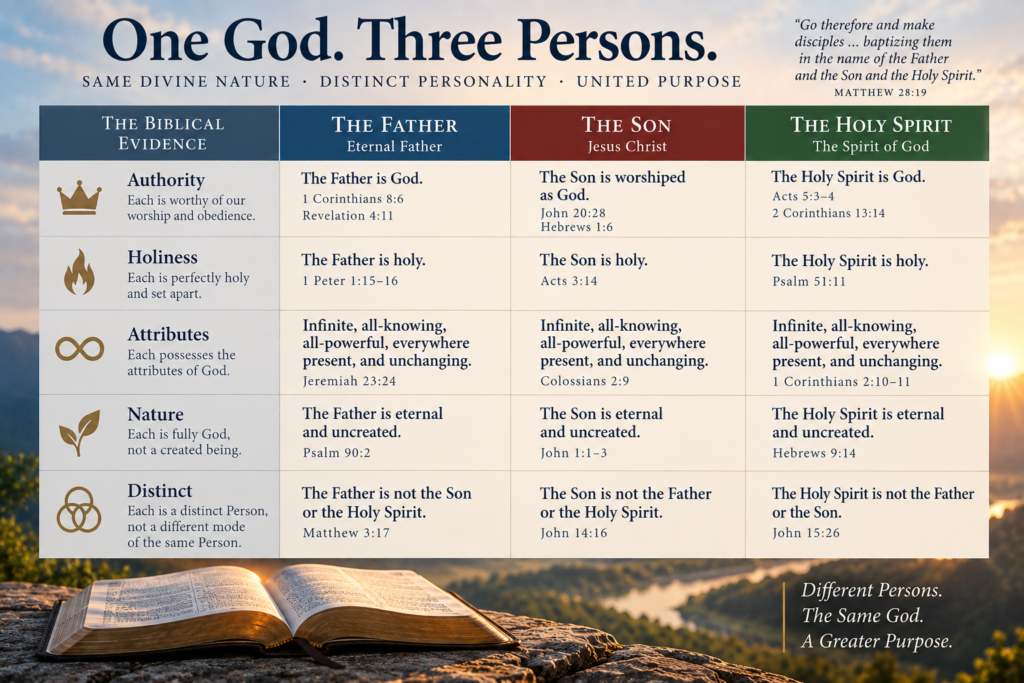
No. Christianity has always affirmed that there is only one God. At the same time, Scripture reveals the Father, the Son, and the Holy Spirit as distinct from one another, while attributing divine nature to each. Christians use the word Trinity to describe this biblical reality: one God who exists eternally as Father, Son, and Holy Spirit.
The word itself can sound complicated, and Christians have sometimes made the subject even more difficult by trying to explain exactly how God’s nature works. We should be careful here. We are finite human beings trying to understand an infinite God. We should expect there to be things about His nature that are beyond our complete understanding.
But mystery does not mean we know nothing. God has revealed important truths about Himself in Scripture, and those truths give us a solid foundation for understanding the Father, Son, and Holy Spirit.
There Is One God
Any biblical understanding of the Trinity must begin here: there is only one God. Christianity is not a belief in three separate gods working together.
God told Israel:
“Hear, O Israel! The LORD is our God, the LORD is one!” (Deuteronomy 6:4)
This truth runs throughout Scripture. God says through Isaiah:
“Before Me there was no God formed, and there will be none after Me.” (Isaiah 43:10)
The New Testament teaches the same thing. Paul writes:
“For there is one God, and one mediator also between God and men, the man Christ Jesus.” (1 Timothy 2:5)
So whatever we mean when we speak of the Father, Son, and Holy Spirit, we cannot mean that there are three gods. Scripture is clear that God is one.
The Father Is God
The deity of the Father is rarely controversial among Christians because Scripture refers to Him as God repeatedly. Jesus prayed to the Father as God, taught His disciples to pray to the Father, and spoke of returning to the Father.
Paul writes:
“Yet for us there is but one God, the Father, from whom are all things and we exist for Him…” (1 Corinthians 8:6)
The Father is God. But Scripture does not stop there.
Jesus Shares in the Divine Nature
The New Testament also presents Jesus in terms that go far beyond those of a prophet, teacher, or created spiritual being. John opens his Gospel with one of the clearest statements:
“In the beginning was the Word, and the Word was with God, and the Word was God.” (John 1:1)
John then identifies this Word with Jesus:
“And the Word became flesh, and dwelt among us…” (John 1:14)
Jesus also claimed a unique unity with the Father:
“I and the Father are one.” (John 10:30)
After the resurrection, Thomas encountered the risen Jesus and responded:
“My Lord and my God!” (John 20:28)
Jesus did not correct him. The New Testament consistently gives Jesus a place that belongs to God. He existed before His human birth, participated in creation, forgave sins, received worship, conquered death, and shares the glory of the Father.
The Holy Spirit Is Divine
As we saw in the previous article, Scripture does the same with the Holy Spirit. Peter tells Ananias that he has lied to the Holy Spirit and then says:
“You have not lied to men, but to God.” (Acts 5:4)
The Spirit is eternal (Hebrews 9:14). He knows the depths of God (1 Corinthians 2:10 – 11). He was active in creation (Genesis 1:2). He gives life (Job 33:4). He inspired Scripture (2 Peter 1:21). He is present wherever God’s presence is found (Psalm 139:7 – 10), and God’s people are called God’s temple because His Spirit dwells within them (1 Corinthians 3:16).
So Scripture presents us with three truths we cannot simply discard: the Father is divine, the Son is divine, and the Holy Spirit is divine.
Yet there is only one God.
The Father, Son, and Spirit Are Distinct
One possible way to avoid the difficulty would be to say that Father, Son, and Holy Spirit are simply three different names for the same Person. Perhaps God sometimes appears as the Father, sometimes as Jesus, and sometimes as the Holy Spirit. But Scripture does not allow that explanation either because the Father, Son, and Holy Spirit interact with one another – they are distinct from one another.
Consider what happens at Jesus’ baptism:
“After being baptized, Jesus came up immediately from the water; and behold, the heavens were opened, and he saw the Spirit of God descending as a dove and lighting on Him, and behold, a voice out of the heavens said, ‘This is My beloved Son, in whom I am well-pleased.’” (Matthew 3:16 – 17)
All three are present. Jesus is in the water. The Spirit descends upon Him. The Father speaks from heaven. They cannot simply be three names for one Person appearing in three different ways.
Jesus makes the distinction equally clear when He promises the Holy Spirit to His apostles:
“I will ask the Father, and He will give you another Helper, that He may be with you forever.” (John 14:16)
Jesus asks the Father, and the Father sends the Helper. Jesus then identifies that Helper as the Holy Spirit. Once again, Father, Son, and Holy Spirit are personally distinct.
Jesus Places All Three Together
One of the clearest passages bringing the three together comes from Jesus’ Great Commission. After His resurrection, Jesus commanded His apostles:
“Go therefore and make disciples of all the nations, baptizing them in the name of the Father and the Son and the Holy Spirit.” (Matthew 28:19)
Notice something interesting about Jesus’ wording. He does not say to baptize them in the names of the Father, Son, and Holy Spirit. He uses the singular word name, while identifying Father, Son, and Holy Spirit.
Paul gives us another beautiful example:
“The grace of the Lord Jesus Christ, and the love of God, and the fellowship of the Holy Spirit, be with you all.” (2 Corinthians 13:14)
The Father, Son, and Spirit are distinct, yet they are repeatedly joined together in the life and work of God.
Different Roles, One Divine Purpose
Although Father, Son, and Holy Spirit share the divine nature, Scripture often describes them carrying out different roles. We can see this clearly in God’s work of salvation.
The Father sends the Son. Jesus comes into the world, takes on human flesh, dies for our sins, and rises from the dead. The Holy Spirit reveals Christ, inspired the Scriptures that testify about Him, brings the message of Christ to the world, dwells within God’s people, and works to transform them into the likeness of Christ.
Jesus describes some of this relationship when He speaks about the coming of the Spirit:
“But the Helper, the Holy Spirit, whom the Father will send in My name, He will teach you all things…” (John 14:26)
The Father sends. The Spirit comes. And He comes in the name of Jesus.
Later Jesus says:
“He will glorify Me, for He will take of Mine and will disclose it to you.” (John 16:14)
This gives us an especially important insight into the relationship between Jesus and the Holy Spirit. The Spirit does not come to compete with Christ or draw attention away from Him. His work glorifies Christ.
Why Every Trinity Analogy Eventually Fails
Christians have developed many illustrations to try to explain the Trinity. Some compare God to water, which can exist as liquid, ice, or vapor. Others point to an egg with its shell, white, and yolk. Still others use the sun, its light, and its heat.
These illustrations may help make one particular point, but every one of them eventually breaks down. Water changing between three forms can suggest that God is one Person who simply appears in different forms, which does not fit the biblical picture. An egg has three parts, but each part is only a portion of the egg, while the Father, Son, and Holy Spirit are not each one-third of God.
Perhaps we should not be surprised that nothing in creation perfectly explains the nature of the Creator.
We can use illustrations carefully, but Scripture itself should remain our foundation. We do not need an analogy that removes every mystery. We need to understand what God has actually revealed about Himself.
Mystery Is Not a Contradiction
Some people object that the Trinity is logically contradictory. But Christianity is not claiming that God is one Person and three Persons at the same time, or that He is one God and three Gods at the same time. That would indeed be a contradiction.
The claim is different. There is one divine Being, and within the one God are three distinct Persons: Father, Son, and Holy Spirit. God is one in one sense and three in another sense.
That may be difficult to fully comprehend, but difficulty is not the same thing as contradiction. There are many realities we know to be true without completely understanding how they work. How much more should we expect that to be true when we are talking about the nature of God?
Why the Trinity Matters to Understanding the Holy Spirit
The Trinity is not merely a theological puzzle for scholars to debate. It helps us understand who the Holy Spirit is and why His presence in our lives matters so much.
The Spirit dwelling within Christians is not a lesser substitute sent because Jesus returned to heaven. God Himself is present with His people through His Spirit. The Father has not abandoned us. Jesus has not left us as orphans. The Holy Spirit has been given to dwell within God’s people, guide us in truth, help us in our weakness, produce His fruit in our lives, and transform us increasingly into the likeness of Christ.
At the same time, understanding the Trinity keeps our focus balanced. The Holy Spirit does not operate independently from the Father and the Son. The Father sends Him. The Son promises Him. The Spirit glorifies Christ. Their work is perfectly united.
There is one God: Father, Son, and Holy Spirit. We may never fully comprehend the mystery of His nature, but Scripture gives us more than enough to know whom we worship and to recognize the extraordinary significance of the Holy Spirit’s presence in our lives.
That brings us to one final foundational question before we begin looking more closely at what the Spirit does: What is the Holy Spirit’s primary purpose?
Want to Go Deeper?
This article is adapted from my book, Understanding the Holy Spirit: A Scriptural Study Guide. If you’d like to explore the Holy Spirit in greater depth, including His indwelling presence, His work in our lives, the fruit of the Spirit, being filled with the Spirit, spiritual gifts, and much more, the complete study is available on Amazon.