

Christians frequently speak about being led by the Holy Spirit. Someone may say, “The Spirit led me to make this decision,” or “I felt the Holy Spirit telling me to do something.” Others describe an inner peace, a sudden conviction, or a strong impression they believe came from God.
But how can we know whether these experiences are actually the work of the Holy Spirit? Does He communicate directly with Christians today? Does He guide us through our thoughts and feelings? Or does His guidance come primarily through the Word He inspired?
These questions matter because Scripture clearly teaches that the Holy Spirit is active in the lives of Christians. Yet it is equally important that we understand what the Bible actually promises rather than assuming that every spiritual impression comes from God.
To understand how the Holy Spirit guides us, we need to begin with a distinction that is often overlooked.
Not Every Promise About the Spirit Was Made to Every Christian
During His final evening with the apostles, Jesus made several extraordinary promises about the coming Holy Spirit. Among them were these words:
“But the Helper, the Holy Spirit, whom the Father will send in My name, He will teach you all things, and bring to your remembrance all that I said to you.” (John 14:26)

Jesus also promised:
“But when He, the Spirit of truth, comes, He will guide you into all the truth…” (John 16:13)
These are wonderful promises, but we must pay attention to their original audience. Jesus was speaking directly to His apostles as He prepared them for His departure. They had personally heard His teaching and witnessed His ministry. They would soon be responsible for proclaiming His message to the world.
When Jesus promised that the Spirit would bring His words to their remembrance, that promise had a particular meaning for men who had actually heard those words. The Spirit would equip them to testify accurately about Jesus and communicate the truth He had entrusted to them.
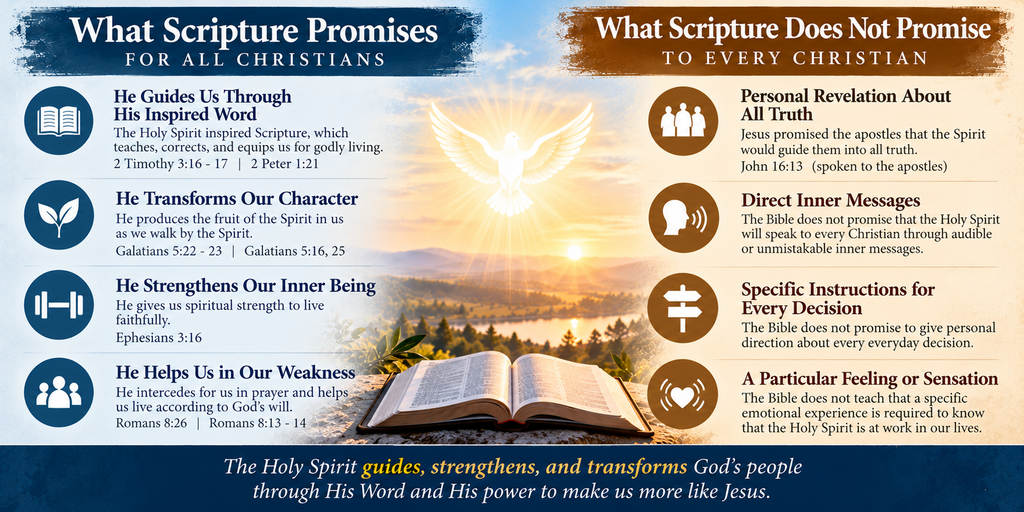
Think about this for a moment… If Jesus said the Holy Spirit would “teach you all things”, and that was for me and you, then He failed. You and I simply don’t know all things (in context, all spiritual things). And God doesn’t fail, so that must not have been for us. He also said that the disciples would remember all the things that Jesus taught them. Clearly, that applies to them, since He didn’t teach us anything to remember.
We should not automatically take these promises, given to the apostles for their unique mission, and apply them in precisely the same way to every Christian today. That does not mean the Spirit no longer works in believers. It means we must look carefully at the passages that describe His work in the lives of Christians generally.
The Holy Spirit Guides Us Through the Word He Inspired
One of the clearest ways the Holy Spirit guides Christians is through Scripture. The Bible is not simply a collection of religious opinions or ancient reflections about God. It is the inspired Word of God.
Peter explains:
“For no prophecy was ever made by an act of human will, but men moved by the Holy Spirit spoke from God.” (2 Peter 1:21)
Paul describes the practical purpose of inspired Scripture:
“All Scripture is inspired by God and profitable for teaching, for reproof, for correction, for training in righteousness; so that the man of God may be adequate, equipped for every good work.” (2 Timothy 3:16 – 17)
Notice the breadth of that statement. Scripture teaches us what is true, corrects us when we are wrong, trains us in righteousness, and equips us for good works. These are precisely the kinds of things we need when seeking God’s guidance.
When Scripture tells us to forgive someone who has wronged us, we do not need to wait for a special spiritual impression before obeying. When God’s Word tells us to avoid sexual immorality, speak truthfully, love our neighbors, and care for those in need, His will has already been revealed.
Let me share a personal story. A few years ago I had a conversation with a person who was not sure if they should be baptized. They had received advice from another Christian that they should pray about it, and the Holy Spirit would tell them what to do. They asked what I thought about that. My short answer was, “He already has told you what to do”. The direction about baptism was clearly revealed in scripture.
The Holy Spirit has given us a reliable, authoritative source of guidance. We should never overlook that gift while searching for something more dramatic.
What Does It Mean to Be Led by the Spirit?
Paul uses the language of being led by the Spirit in Romans:
“For all who are being led by the Spirit of God, these are sons of God.” (Romans 8:14)
Some interpret this verse as a promise that the Holy Spirit will provide personal instructions about everyday decisions. But the surrounding context points in a particular direction. Immediately before this statement, Paul writes:
“For if you are living according to the flesh, you must die; but if by the Spirit you are putting to death the deeds of the body, you will live.” (Romans 8:13)
Paul is discussing the difference between living according to sinful human desires and living according to the Spirit. Being led by the Spirit is connected with putting sin to death and living as God’s children. That is much more significant than simply receiving help with occasional decisions. The Spirit’s leadership concerns the direction and character of our entire lives.
He leads us away from the flesh and toward holiness.
Walking by the Spirit
Paul develops this same theme in Galatians:
“But I say, walk by the Spirit, and you will not carry out the desire of the flesh.” (Galatians 5:16)
He then contrasts the works of the flesh with the fruit of the Spirit. The works of the flesh include immorality, jealousy, anger, selfish ambition, and other sinful behaviors. The fruit of the Spirit includes love, joy, peace, patience, kindness, goodness, faithfulness, gentleness, and self-control.
Later, Paul adds:
“If we live by the Spirit, let us also walk by the Spirit.” (Galatians 5:25)
Again, the emphasis is not on receiving secret information or supernatural instructions about ordinary choices. It is on allowing the Spirit’s work to shape the way we live. A person who is walking by the Spirit should increasingly demonstrate Christ-like character. That person should become more loving, patient, self-controlled, and faithful.
This is one of the most important biblical tests of spiritual maturity. The evidence of the Spirit’s work is not merely what someone claims to hear from God, but what kind of life that person is living.
The Spirit Strengthens Our Inner Being
Scripture also teaches that the Holy Spirit strengthens believers spiritually. Paul prayed for the Christians in Ephesus:
“That He would grant you, according to the riches of His glory, to be strengthened with power through His Spirit in the inner man.” (Ephesians 3:16)
This is a wonderful promise of spiritual strength. Paul was not praying that the Ephesians would receive new revelations about their daily decisions. He was praying that God would strengthen them inwardly through His Spirit.
We need that strength. Christians face temptation, discouragement, suffering, and the constant challenge of remaining faithful to Christ. The Spirit’s work is not limited to providing information. He strengthens us to live according to the truth God has already revealed. Paul’s prayer continues by connecting this strengthening with Christ dwelling in their hearts through faith and their being rooted and grounded in love (Ephesians 3:17).
The Spirit’s work, once again, is deeply connected with spiritual maturity and becoming more like Christ.
Does the Holy Spirit Speak Through Inner Impressions?
Many Christians believe that the Holy Spirit sometimes guides them through an inner impression, a strong conviction, or an unusual sense that they should take a particular action. Others are more cautious about identifying such experiences as direct communication from God.
We should recognize that Scripture records occasions when God communicated directly with individuals. In Acts, the Spirit directed Philip toward the Ethiopian official (Acts 8:29), instructed Peter concerning Cornelius’s messengers (Acts 10:19 – 20), and directed the church at Antioch to set apart Barnabas and Saul (Acts 13:2).
These events were real. But recording an event is not the same as promising that every Christian will experience the same kind of communication. We should therefore be careful about treating our thoughts, emotions, or impressions as though they carry the same authority as Scripture.
A strong feeling may arise from many sources, including personal desires, past experiences, fears, or ordinary human judgment. Even sincere Christians can misunderstand their own motivations.
If someone says, “I believe God may be leading me in this direction,” that is quite different from declaring, “God told me to do this.” The second statement claims divine authority for something that may actually be a personal judgment. Further, it’s useful to remember that nowhere in Scripture do we see God hinting at things, or providing some kind of urge. When God wants to do something, He does it.
I once heard someone talking about how the Holy Spirit could guide us. He urged people to be very quiet, to pray, and then to listen. The man said that God wants to talk to you, but we just don’t listen. That seems a little absurd to me. If God wants to talk to you He will. The idea that my own lack of listening can overpower God’s ability to speak makes no sense.
How Can We Test What We Believe Is God’s Guidance?
The New Testament repeatedly warns Christians not to accept every spiritual claim without examination. John writes:
“Beloved, do not believe every spirit, but test the spirits to see whether they are from God…” (1 John 4:1)
In its immediate context, John is warning about false prophets and testing their teaching concerning Jesus Christ. The principle is clear: claims of spiritual authority must be examined rather than accepted automatically.
Paul similarly instructs Christians:
“But examine everything carefully; hold fast to that which is good.” (1 Thessalonians 5:21)
These passages remind us that spiritual claims should never be exempt from careful evaluation.
When considering a decision, we should begin by asking whether it agrees with Scripture. God will not guide us to violate His own revealed will. We should also consider whether the decision reflects godly character, sound judgment, and genuine love for others.
Seeking wise counsel can be helpful as well. The wonderful book of Proverbs repeatedly emphasizes the value of counsel, understanding, and wisdom.
None of these practices requires us to claim that every conclusion we reach is a direct revelation from the Holy Spirit. They allow us to make responsible decisions while submitting ourselves to God’s revealed truth.
What About Peace as a Sign of God’s Guidance?
Christians sometimes say that they know God wants them to make a particular decision because they feel peace about it. Others assume that anxiety or uncertainty must mean the Holy Spirit is warning them against a choice.
But feelings of peace are not an infallible guide to God’s will.
People can feel comfortable about unwise decisions, and they can feel deeply uncomfortable about doing what is right. Jesus Himself experienced profound anguish before His crucifixion, yet He remained completely obedient to the Father.
Paul encourages Christians to bring their concerns to God in prayer and promises that God’s peace will guard their hearts and minds in Christ Jesus (Philippians 4:6-7). That is a wonderful assurance, but the passage does not teach that a feeling of peace automatically identifies which option God wants us to choose.
We should be thankful for the peace God provides without turning our emotions into a substitute for biblical wisdom.
God Has Given Us Wisdom and Responsibility
Sometimes Christians approach decisions as though God has hidden one correct answer and their responsibility is to discover it through spiritual impressions. But Scripture frequently calls believers to exercise wisdom, discernment, and responsible judgment.
James writes:
“But if any of you lacks wisdom, let him ask of God, who gives to all generously and without reproach, and it will be given to him.” (James 1:5)
God invites us to seek wisdom. That wisdom should shape how we evaluate circumstances, consider consequences, and make decisions consistent with His Word.
For example, a Christian choosing between two legitimate job opportunities may need to consider family responsibilities, financial circumstances, opportunities for service, and long-term consequences. Scripture may not identify one particular employer as God’s chosen answer. Instead, it provides principles that help the person make a wise and faithful decision.
We can pray for wisdom, seek counsel, examine the relevant facts, and make responsible choices without claiming divine certainty about matters God has not specifically revealed.
The Spirit’s Guidance Is About More Than Decisions
Perhaps the greatest mistake we can make is reducing the Holy Spirit’s guidance to questions such as which job to accept, which house to buy, or which direction to take in life. Those decisions matter, but Scripture emphasizes something far greater.
The Holy Spirit is at work transforming God’s people. He helps us put sin to death, strengthens our inner being, produces Christlike character, and helps us live faithfully before God.
When Paul tells Christians to walk by the Spirit, he is describing a way of life, wherein we walk in concert with God’s moral code. The Spirit’s guidance is not merely occasional assistance with difficult choices. It is part of God’s ongoing work of making us more like Jesus.
That is a much richer understanding of what it means to be Spirit-led.
Following the Spirit Faithfully
How, then, should Christians seek the Holy Spirit’s guidance today?
We should begin with confidence in the Word He inspired. Scripture gives us the truth we need for faith and godly living. We should pray for wisdom, examine our motives, seek wise counsel, and make decisions consistent with God’s revealed will.
We should also recognize that the Spirit is genuinely active within us. He strengthens us spiritually, helps us resist sin, and produces the character of Christ as we walk according to His leading.
We do not need to claim a private revelation for every decision in order to live a Spirit-led life. Nor should we diminish the Spirit’s work simply because it does not always appear in dramatic or supernatural ways.
The clearest evidence of the Spirit’s guidance is not that we claim to hear His voice, but that our lives increasingly reflect the truth and character of Jesus Christ.
In our next article, we will examine one of the most personal aspects of the Spirit’s work: How Does the Holy Spirit Help Us in Prayer?
Want to Go Deeper?
This article is adapted from my book, Understanding the Holy Spirit: A Scriptural Study Guide. If you’d like to explore the Holy Spirit in greater depth, including His indwelling presence, His work in our lives, the fruit of the Spirit, being filled with the Spirit, spiritual gifts, and much more, the complete study is available on Amazon.