

How can you tell whether the Holy Spirit is working in your life? This is a question many Christians ask, especially when they hear others describe dramatic spiritual experiences, powerful emotions during worship, or moments when they believe God spoke directly to them.
Some believers may wonder whether they are missing something. They haven’t spoken in tongues, experienced an overwhelming spiritual sensation, or heard the voice of God. Does that mean the Holy Spirit is not active in their lives?
Scripture gives us a much more reliable way to think about this question. The New Testament certainly records extraordinary manifestations of the Holy Spirit, particularly during the establishment and expansion of the early church. But when the apostles wrote to Christians about everyday spiritual life, they placed enormous emphasis on character, holiness, faithfulness, and becoming more like Jesus Christ.
These are not necessarily dramatic changes. They may develop gradually over many years. Yet they represent some of the most important evidence of the Spirit’s work within us.
Begin With What Scripture Actually Promises
Before examining the evidence of the Spirit’s work, we should remember something established earlier in this series: the Holy Spirit’s presence is not reserved for a special class of Christians.
Paul writes:
“However, you are not in the flesh but in the Spirit, if indeed the Spirit of God dwells in you. But if anyone does not have the Spirit of Christ, he does not belong to Him.” (Romans 8:9)
Paul connects the presence of the Holy Spirit with belonging to Jesus Christ. He does not establish miraculous gifts, unusual sensations, or extraordinary religious experiences as prerequisites for receiving the Spirit.
This distinction matters because we should not confuse the presence of the Spirit with our ability to recognize every aspect of His work. A Christian may genuinely belong to Christ while struggling to understand how the Spirit is working in particular circumstances.
Our confidence should begin with God’s revealed promises rather than our changing emotions.
The Fruit of the Spirit Is Important Evidence
Perhaps the clearest description of the Spirit’s transforming work appears in Paul’s letter to the Galatians:
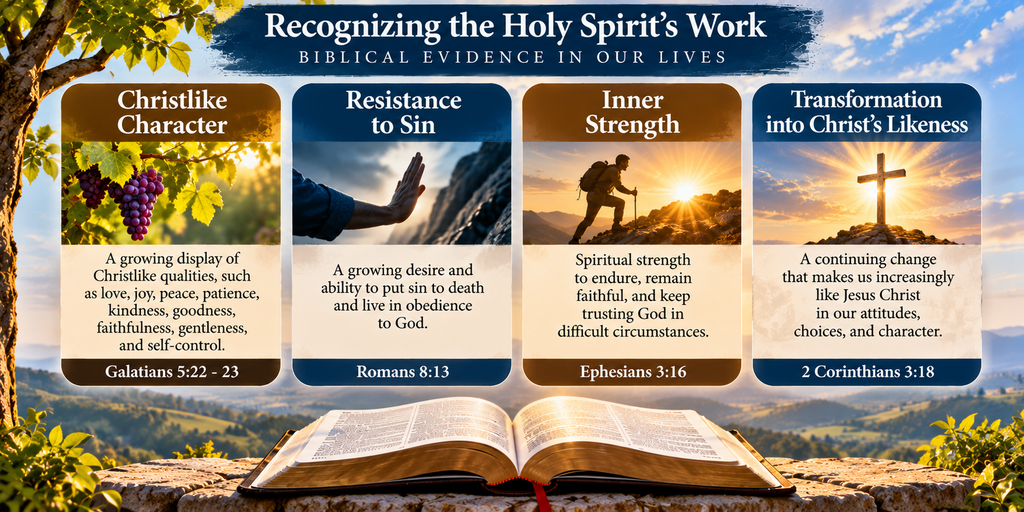
“But the fruit of the Spirit is love, joy, peace, patience, kindness, goodness, faithfulness, gentleness, self-control; against such things there is no law.” (Galatians 5:22 – 23)

Notice what Paul emphasizes. He does not begin with miraculous abilities, visions, or extraordinary spiritual experiences. He describes qualities of character that increasingly reflect the nature of Jesus Christ. Love changes how we treat other people. Patience affects our response to frustration. Kindness influences our words and actions. Self-control helps us resist sinful desires. Faithfulness shapes our commitment to God and to others.
These qualities may not attract the attention that miraculous claims sometimes receive, but they are central to the Christian life. Paul calls them the fruit of the Spirit because they are the result of His work. Just as a healthy tree produces fruit consistent with its nature, a life increasingly influenced by the Holy Spirit should reflect His character. We will explore each of these qualities more thoroughly in our later section on the fruit of the Spirit. For now, the important point is that Christlike character is a major biblical indicator of the Spirit’s work.
Spiritual Growth Is Usually a Process
One mistake Christians sometimes make is expecting spiritual transformation to happen immediately. They may assume that receiving the Holy Spirit should eliminate every struggle with anger, selfishness, impatience, or temptation.
But the New Testament describes Christian growth as an ongoing process.
Paul writes:
“But we all, with unveiled face, beholding as in a mirror the glory of the Lord, are being transformed into the same image from glory to glory, just as from the Lord, the Spirit.” (2 Corinthians 3:18)
Notice the expression are being transformed. Paul describes an ongoing change rather than a single event that instantly produces complete spiritual maturity.
This should encourage Christians who recognize areas of weakness in their lives. The presence of spiritual struggles does not automatically mean the Spirit is absent. What matters is whether we are responding to God’s truth, resisting sin, and growing toward greater faithfulness.
Someone who once responded to every disagreement with anger may gradually become more patient. A person who struggled with bitterness may learn to forgive. Someone who was consumed by selfish ambition may increasingly seek opportunities to serve others.
These changes may be difficult to measure from one day to the next, but over time they can become significant.
A Growing Desire to Resist Sin
Another important evidence of the Spirit’s work is the growing desire to reject sinful behavior and live according to God’s will.
Paul writes:
“For if you are living according to the flesh, you must die; but if by the Spirit you are putting to death the deeds of the body, you will live.” (Romans 8:13)
The phrase putting to death describes an active struggle against sin. Paul does not suggest that Christians become passive observers while the Spirit automatically removes every sinful desire. Instead, believers are responsible for resisting sin, and they do so by the Spirit. That distinction is important. The Spirit’s work does not eliminate human responsibility. He helps us live in obedience to God rather than surrendering to the desires of the flesh.
We may still experience temptation, and we may sometimes fail. But a growing willingness to acknowledge sin, repent, and pursue righteousness is consistent with the Spirit’s transforming work. Spiritual maturity is not demonstrated by pretending that we never struggle. It is demonstrated by increasingly submitting our lives to God’s revealed will.
Greater Love for God and Others
One of the most significant changes the Holy Spirit produces is love.
Paul writes:
“And hope does not disappoint, because the love of God has been poured out within our hearts through the Holy Spirit who was given to us.” (Romans 5:5)
This passage describes God’s love being poured into the hearts of believers through the Holy Spirit. That love provides a foundation for Christian hope and shapes our relationship with God. The New Testament also repeatedly connects genuine spiritual life with love for others. Paul explains that even extraordinary spiritual abilities are worthless without love:
“If I speak with the tongues of men and of angels, but do not have love, I have become a noisy gong or a clanging cymbal.” (1 Corinthians 13:1)
He continues by explaining that knowledge, faith, generosity, and even remarkable sacrifices accomplish nothing of lasting spiritual value when separated from love. This is a powerful reminder that spiritual maturity should not be measured primarily by extraordinary claims or impressive religious accomplishments. A person who possesses extensive biblical knowledge but consistently treats others with arrogance, cruelty, or contempt is failing to demonstrate one of the most important qualities Scripture associates with spiritual growth.
The Spirit’s work should increasingly lead us toward the love demonstrated by Jesus Christ.
The Spirit Strengthens Us Inwardly
Not every aspect of the Spirit’s work is immediately visible to other people. Scripture also describes His ministry of strengthening believers inwardly. Paul prayed for the Christians in Ephesus:
“That He would grant you, according to the riches of His glory, to be strengthened with power through His Spirit in the inner man.” (Ephesians 3:16)
Paul’s prayer continues by connecting this spiritual strengthening with Christ dwelling in their hearts through faith and their being rooted and grounded in love. This strengthening may become evident in the way Christians endure difficulties, resist temptation, remain faithful during suffering, and continue trusting God when circumstances are uncertain. It does not necessarily mean that believers will feel powerful or emotionally confident at every moment. Paul himself experienced weakness, suffering, and discouragement.
Spiritual strength is not the absence of difficulty. It is the ability to remain faithful to Christ in the midst of it.
Faithfulness to God’s Word
The Holy Spirit inspired the Scriptures, and His work in our lives will never contradict the truth He revealed. Peter explains the divine origin of prophecy:
“For no prophecy was ever made by an act of human will, but men moved by the Holy Spirit spoke from God.” (2 Peter 1:21)
Paul describes the practical value of Scripture:
“All Scripture is inspired by God and profitable for teaching, for reproof, for correction, for training in righteousness.” (2 Timothy 3:16)
These passages remind us that God’s Word provides an objective standard for Christian belief and conduct. If someone claims that the Holy Spirit is leading them to disregard clear biblical teaching, we should question that claim. The Spirit does not contradict the truth He inspired.
Growing faithfulness to Scripture is therefore an important part of spiritual maturity. As Christians study God’s Word, understand its teaching, and apply it to their lives, they are responding to the truth the Spirit has revealed. This does not mean that every Christian will understand every difficult passage immediately or agree with every interpretation offered by others. Careful study, humility, and discernment remain essential. But a growing commitment to knowing and obeying God’s Word is consistent with the Spirit’s work in our lives.
What About Spiritual Experiences?
Christians sometimes describe experiences they believe are connected with the Holy Spirit. These may include a powerful sense of conviction, unusual joy during worship, a strong impression during prayer, or a dramatic change in their circumstances. We should not automatically dismiss someone’s experience simply because it is unusual. Scripture records many extraordinary events involving the Holy Spirit.
At the same time, we should not assume that every intense emotion or unusual occurrence is necessarily a direct manifestation of the Spirit. Human emotions are complex. Music, circumstances, expectations, personal relationships, and many other factors can influence how we feel. A powerful experience may be meaningful without establishing that God has communicated a particular message. Scripture repeatedly calls Christians to exercise discernment. John writes:
“Beloved, do not believe every spirit, but test the spirits to see whether they are from God.” (1 John 4:1)
John was specifically addressing the need to test false prophets and their teaching about Christ. His warning reminds us that spiritual claims must be evaluated rather than accepted automatically. Experiences should be examined in light of Scripture, not used to override it.
Miraculous Gifts Are Not the Universal Measure
Some Christians believe that speaking in tongues or exercising another miraculous spiritual gift is the clearest evidence that someone has received the Holy Spirit. But the New Testament does not teach that every Christian possesses the same spiritual gifts. Paul writes:
“But one and the same Spirit works all these things, distributing to each one individually just as He wills.” (1 Corinthians 12:11)
Later, he asks:
“All do not speak with tongues, do they?” (1 Corinthians 12:30)
The expected answer is no. Whatever conclusions Christians reach about the continuation of miraculous gifts today (and I’ll have more to say on this in this article series), Paul’s teaching makes clear that possessing a particular gift is not a universal requirement for belonging to Christ.
In fact, the Corinthian church possessed remarkable spiritual gifts while also struggling with division, pride, jealousy, and immaturity. That is one reason Paul placed such strong emphasis on love in 1 Corinthians 13. Spiritual abilities do not automatically establish spiritual maturity. We should therefore be cautious about measuring the Holy Spirit’s work through extraordinary experiences or gifts.
Can We Measure Our Spiritual Progress?
It is reasonable for Christians to examine their lives and consider whether they are growing spiritually. Paul encouraged believers to examine themselves (2 Corinthians 13:5), and Scripture repeatedly calls us to pursue maturity. But spiritual growth is not always easy to measure. Some changes are gradual. Others may become apparent only when we encounter a difficult situation and recognize that we respond differently than we once would have.
For example, someone who previously responded to criticism with anger may discover that they can now listen patiently. A person who once struggled to forgive may find that resentment no longer controls their thoughts. Another Christian may recognize greater confidence in God’s promises during a season of suffering.
These changes can be encouraging, but we should avoid turning spiritual growth into a competition or a checklist designed to prove our superiority over others. Christians grow at different rates and face different challenges. The goal is not to compare ourselves with one another, but to become increasingly like Christ.
The Spirit’s Work Always Points Toward Christ
Throughout this series, we have emphasized that the Holy Spirit’s work is centered on Jesus Christ. Jesus told His apostles:
“He will glorify Me, for He will take of Mine and will disclose it to you.” (John 16:14)
In its original setting, this promise concerned the Spirit’s ministry to the apostles as they prepared to proclaim the truth about Jesus. It helps us understand the Christ-centered character of the Spirit’s work without assuming that every detail of the promise applies identically to Christians today.
Paul describes the transforming work of the Spirit in similar terms:
“But we all, with unveiled face, beholding as in a mirror the glory of the Lord, are being transformed into the same image from glory to glory, just as from the Lord, the Spirit.” (2 Corinthians 3:18)
The direction of this transformation is clear. The Spirit is making God’s people increasingly like Christ. That provides an important standard for evaluating claims about spiritual maturity. Does a person’s life increasingly reflect the character and teaching of Jesus? Is there growing humility, love, holiness, and faithfulness? These questions direct our attention toward the purpose of the Spirit’s work rather than toward the excitement of particular experiences.
Recognizing the Spirit’s Work Without Becoming Self-Focused
There is one final caution worth considering. It is possible to become so preoccupied with evaluating our spiritual condition that we lose sight of the One we are supposed to follow. The Christian life is not meant to be an endless search for evidence that we are sufficiently spiritual. Our attention should remain centered on Jesus Christ, His Word, and faithful obedience to Him.
As we grow in understanding Scripture, resist sin, practice love, and pursue holiness, we are responding to the very purposes the New Testament associates with the Spirit’s work. We should be grateful when we recognize genuine spiritual growth, but we should not become discouraged simply because that growth is gradual or less dramatic than someone else’s experience.
God’s work in our lives is often accomplished through ordinary faithfulness over time.
The Evidence That Matters Most
How, then, can we recognize the Holy Spirit’s work in our lives?
We should look for the qualities Scripture identifies: growing love, patience, kindness, self-control, holiness, spiritual strength, and faithfulness to God’s Word. We should recognize the Spirit’s work as we become more willing to resist sin, more committed to serving others, and more devoted to Jesus Christ.
None of these qualities means that we have achieved perfection. Spiritual growth is a continuing process, and every Christian still needs God’s grace. But the direction of our lives matters.
The most important evidence of the Holy Spirit’s work is not how extraordinary our experiences have been, but how increasingly our lives reflect Jesus Christ.
That brings us to the conclusion of this section on the indwelling Spirit. In the next section, we will turn our attention to the spiritual world, including what Scripture reveals about angels, demons, Satan, and the Christian’s spiritual struggle.
Want to Go Deeper?
This article is adapted from my book, Understanding the Holy Spirit: A Scriptural Study Guide. If you’d like to explore the Holy Spirit in greater depth, including His indwelling presence, His work in our lives, the fruit of the Spirit, being filled with the Spirit, spiritual gifts, and much more, the complete study is available on Amazon.